Annual Analysis of Political Agendas and Campaigns - Human Rights Watch
Contents
2012: Far Beyond the Curve: HRW’s Bias and Lack of Credibility in 2012, January 30, 2013
2011: HRW in 2011: More Balance, Less Credibility, January 9, 2012
2010: HRW in 2010: More Bias, Even Less Credibility, January 6, 2011
2009: Obsession and Scandals: HRW in 2009, January 5, 2010
2008: Examining Human Rights Watch in 2008: Double Standards and Post-Colonial Ideology, January 13, 2009
2007: NGO Monitor’s 2007 Report on HRW: Bias and Double Standards Continue, April 29, 2008
2006: Report on HRW’s Activities in 2006: Political Bias Undermines Human Rights, June 26, 2007
2005: Human Rights Watch in 2005: Political Bias Against Israel Continues Despite Wider Middle East Focus, April 6, 2006
2012
Far Beyond the Curve: HRW’s Bias and Lack of Credibility in 2012, January 30, 2013
Summary
Human Rights Watch (HRW) epitomizes the ongoing crisis and moral failure of powerful non-governmental organizations (NGOs) that claim to promote the universal principles of human rights. The following review of HRW’s 2012 activities, particularly in the Middle East, demonstrates that little has changed compared to previous years, and that the same individuals continue to control the organization’s agenda and activities.
In particular, HRW’s activities reflect the absence of professional standards and research methodologies; lack of expertise on international law and armed conflict; and a deep-seated ideological bias against democracies in general, and against Israel, in particular. Under the ongoing leadership of Kenneth Roth, these failings, that led HRW founder Robert Bernstein to condemn his own organization in the New York Times in 2009, have continued in 2012. As shown below, Roth’s obsession with Israel was particularly evident in his social media postings.
HRW’s deep bias and lack of credibility in 2012 was seen in:
- its failure to recognize and condemn the genocidal threats emanating from the leadership of the Iranian government (as highlighted in the Wall Street Journal and other media platforms);
- the conflict over Richard Falk’s membership and then forced resignation from an HRW board;
- criticism from women’s groups that Roth acted as “an apologist, not a senior human rights advocate,” in urging support for the new Muslim Brotherhood regimes in Egypt and Tunisia;
- a French newspaper, Liberation, reported that an investigator from HRW offered financial compensation for testimony related to Congolese rebel groups.
Rights violations and armed conflicts that are out of the media focus continue to get little to no attention from HRW. On Israel, while HRW issued fewer condemnations in 2012 in comparison to previous years, NGO Monitor’s quantitative analysis of HRW’s activities in the Middle East and North Africa (MENA) region for 2012 demonstrates that the emphasis continues to be the result of the mix between ideology and the degree of media attention to specific issues. This reflects the ongoing roles of Sarah Leah Whitson and Joe Stork, whose strong ideological agendas have severely distorted MENA’s priorities. Whitson remains MENA director, despite having endorsed the Qaddafi regime as human rights reformers – tainting all HRW statements on Libya – and having led HRW’s fund-raising trip to Saudi Arabia.
In November and December, in response to increased violence related to Gaza, the Palestinian statehood bid in the UN General Assembly, and other developments, HRW’s lack of a credible methodology and anti-Israel bias were further evidenced. Disproportionate condemnations of Israeli actions related to Hamas infrastructure erased vital contextual information. And, although HRW issued a statement on Palestinian rocket attacks from Gaza targeting Israeli civilians, this belated publication added no information to the conventional wisdom, and there was no public relations follow-up. In contrast, earlier in 2012, HRW invested significant resources in attempting to spin the court decision on the Rachel Corrie-ISM case for use in the ongoing demonization campaign against Israel.
HRW vs. Israel in 2012 – Content Analysis
Silence on Iran and Genocide
On December 4, 2012, David Feith published an op-ed in the Wall Street Journal, “Dancing Around Genocide,” which documented HRW’s consistent failure to condemn Iran’s calls to annihilate Israel. Feith disclosed internal emails between Executive Director Kenneth Roth and other members of the organization, in which Roth claimed that “Many of [Iran’s] statements are certainly reprehensible, but they are not incitement to genocide. No one has acted on them.” Feith…, concluding that “Tehran will continue to call for Israel’s obliteration—and Human Rights Watch will continue to sit back and watch.”
A second article on this topic, in Tablet (“The Human Rights Watch Internal Battle on Iran,” December 6, 2012), contained additional leaked emails from Roth. In one, Roth compared Iran’s religious rulers with a prominent Israeli rabbi, alleging that “Rabbi Ovadia Yosef’s statements [on Iran, Hezbollah, and Palestinians] are arguably more direct than those made by Iranian leaders, and Israel, unlike Iran, has the means to carry them out.” The author, Adam Chandler, criticized Roth for failing to acknowledge that Yosef’s remarks were condemned by the Israeli government and that “he is neither a head of state nor an official who sets government policy,” in contrast to the leaders of the Iranian regime.
This story was also covered in the Jerusalem Post, quoting NGO Monitor president Prof. Gerald Steinberg “This is a blatant example of Roth’s indifference to genocidal threats and human rights abuses when these target Israel. Roth…has consistently demonstrated an obsession with attacking the Jewish state, and the people he selected to lead HRW’s Middle East and North Africa division are also infected with this deep bias.”
In addition, in May 2012, HRW founder Robert Bernstein, Prof. Irwin Cotler, and Stuart Robinowitz published an op-ed in the Wall Street Journal, “Inciting Genocide Is a Crime.” While not mentioning HRW explicitly, they noted, “Silence is not a moral option when states threaten genocide—especially when they are on the verge of acquiring nuclear weapons and boast that they can bring about a holocaust in a matter of minutes.”
Roth’s silence and his “quibbling” regarding Iranian genocidal language was also discussed in The New Republic article about HRW “Minority Report,” Ben Birnbaum, April 27, 2010.
Operation Pillar of Defense
In 2012, the main military conflict involving Israel took place in November, when the IDF responded following escalating attacks from Gaza. In the wake of this 8-day conflict, HRW published 6 documents, including 5 press releases and a “Q & A”.
In these documents, as in its previous publications related to armed conflicts, HRW published faulty factual and legal analysis to accuse Israel of “unlawful” attacks against a home and against buildings used by journalists and the media. (The IDF targeted the communications arrays and antennas belonging to Al Aqsa and Al Quds TV, whose operations are an integral part of the Hamas military structure. Al Aqsa is listed as a Specially Designated Global Terrorist by the U.S. Treasury Department. In a tweet, Roth characterized these news outlets simply as “pro-Palestinian,” deceptively stripping away the essential context of terrorism and combat.)
These examples again highlighted the fact that HRW possesses neither the military expertise nor the necessary fact-finding methodology to make these assessments. (Such judgments require knowledge of the military intelligence possessed by Israeli commanders at the time of the strikes, and information on intent of the officers.) In both instances, HRW’s “evidence” for violating international law consisted solely of Israel’s refusal to explain its operational decisions to the NGO.
As in the past, (including a 2003 report on Palestinian suicide bombings), in order to present a façade of balance and credibility, HRW published a press release that condemned “Palestinian armed groups in Gaza” for violating “the laws of war during the November 2012 fighting by launching hundreds of rockets toward population centers in Israel.” (The short document was published on December 24, and was not the subject of an ongoing HRW public relations effort, in contrast to many of its statements on Israel.) It is significant to note that prior to the Israeli action, while numerous rocket attacks were launched from Gaza – each one a war crime – HRW had remained conspicuously silent.
Ken Roth’s Personal Animus
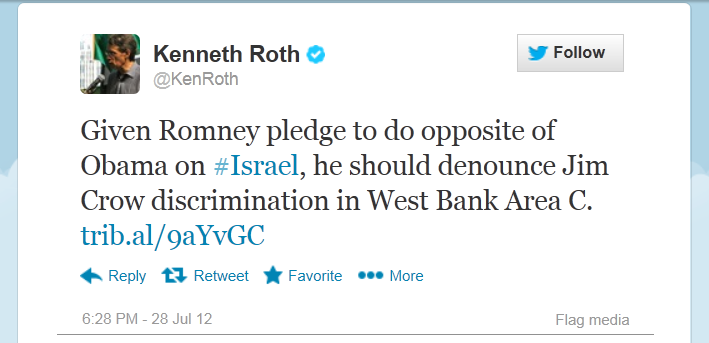
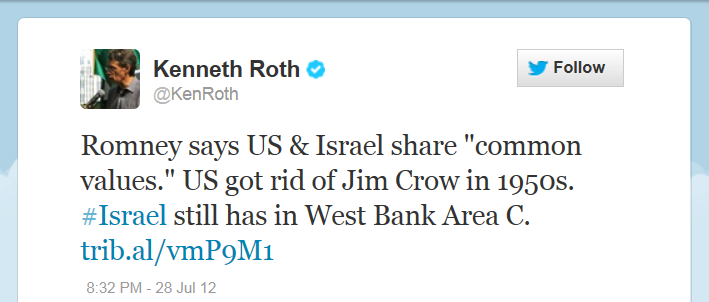
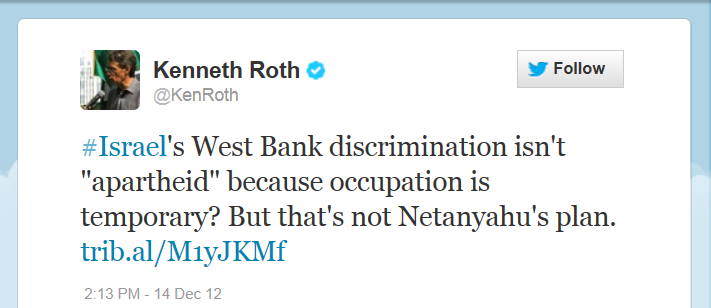
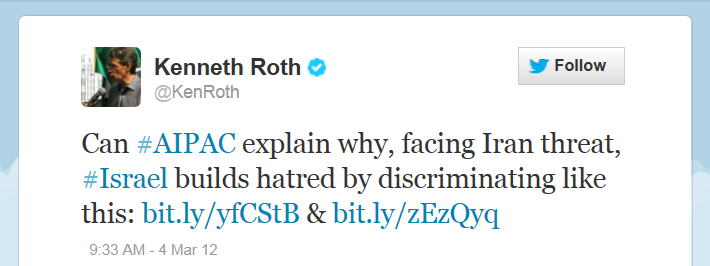
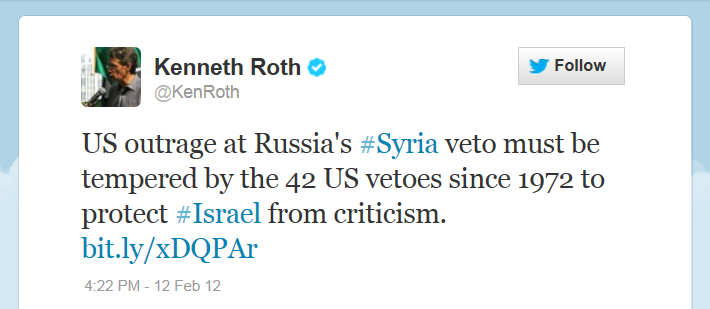
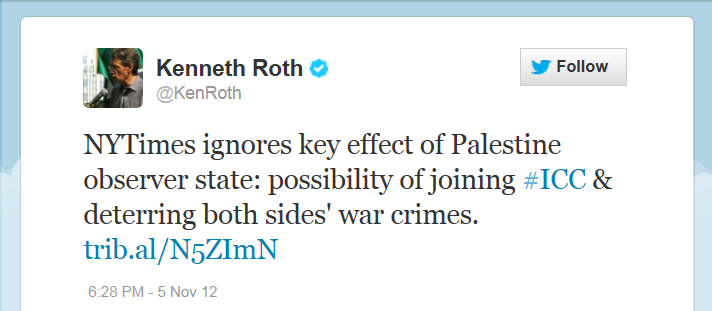
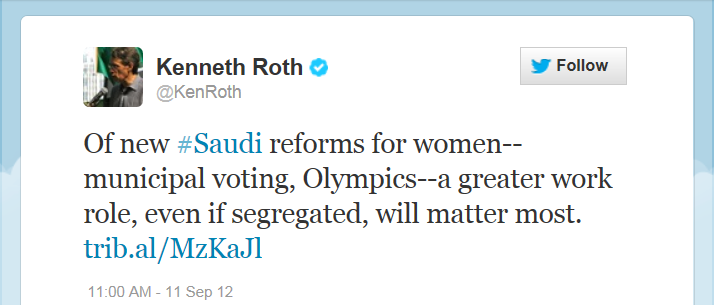
In the past decade, Executive Director Kenneth Roth’s obsession with Israel has been reflected in his op-ed articles and social media posts. For instance, in an op-ed ostensibly about eight countries other than Israel (“Barack Obama: Dump These 8 Unsavory Allies,” Foreign Policy, January 2, 2013), Roth opened with a lengthy attack against American support for the nation-state of the Jewish people. Using highly offensive rhetoric and false analogy, he criticized President Obama for refusing to stop the alleged “Jim Crow-like separate-and-unequal treatment of Palestinians in Israeli-controlled parts of the West Bank” and for condemning the politicized legal initiatives targeting Israel (“lawfare”) based on the Durban Strategy.
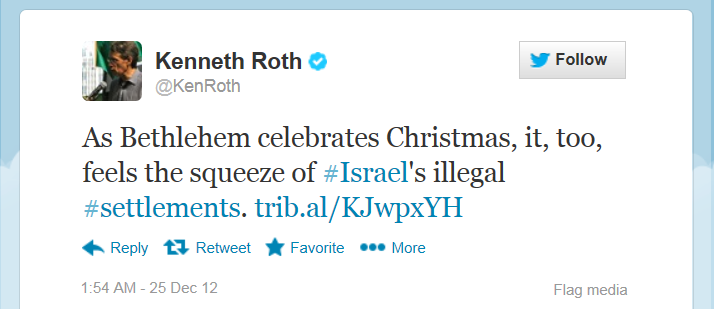
Roth has also used his Twitter account to accuse Israel of “Jim Crow” racism, imply that it is pursuing an “apartheid” policy, and engage in other strident attacks. In contrast, and evidencing his immoral bias, Roth excused gender segregation in Saudi Arabia. Examples include:
 |
 |
 |
 |
 |
 |
 |
 |
 |
The UN General Assembly and Palestinian Statehood
In response to the November 29 UN General Assembly vote recognizing Palestine as a Non-member Observer State, HRW issued a press release under the heading “Newest ‘Observer State’ Should Act on Rights Treaties.” In it, HRW called on “Palestinian leaders [to] pursue ratification of core international human rights treaties and the Rome Statute of the International Criminal Court (ICC).”
This statement is part of HRW’s wider lobbying on behalf of ICC activism – which included playing a central role in its creation and formulating key articles in the statute – and specifically for opening an ICC case against Israeli officials. Along with the Arab League, the Palestinian Authority, and other NGOs, HRW submitted material to the ICC Prosecutor regarding the 2009 Gaza conflict, in the campaign to persuade him to open an investigation into Israel’s conduct.
HRW argues that “Palestinian ratification of the ICC statute would diminish the accountability gap for serious international crimes, including war crimes, and contribute to justice for victims of abuses.” In this respect, HRW is echoing the sentiments of Palestinian Authority President Mahmoud Abbas in his May 2011 New York Times op-ed, that the purpose of the various UN initiatives is not Palestinian statehood per se, but rather a means to pursue legal attacks on Israel:
“Palestine’s admission to the United Nations would pave the way for the internationalization of the conflict as a legal matter, not only a political one. It would also pave the way for us to pursue claims against Israel at the United Nations, human rights treaty bodies and the International Court of Justice.”
HRW’s support for Palestinian initiatives against Israel in the ICC contradicts earlier HRW statements that labeled as a “myth” the notion that “The Court will be used to pursue politically motivated cases against Israel.” UN Watch points to HRW’s 2001 defense of the ICC, where it claimed that
“Future actions on Israeli or Palestinian territory will be covered only if the ICC treaty is ratified by Israel or by a broadly recognized Palestinian state. That probably would not happen until after an Israeli-Palestinian peace agreement, in which case the likelihood of Israeli military action against Palestinians will greatly diminish.”
According to UN Watch, HRW is “flip-flopping” and betraying “prior promises.”
After Public Embarrassment, Richard Falk Removed from HRW Committee
On December 17, UN Watch wrote an open letter to Ken Roth, expressing dismay about UN official Richard Falk’s membership on HRW’s Santa Barbara Committee. UN Watch highlighted Falk’s antisemitism, support for Hamas, and spreading of 9/11 conspiracy theories, for which he has been widely criticized. The letter stated, “By legitimizing this racist and enemy of human rights, your organization undermines its own founding principles. We urge you to remove him immediately.”
Later that day, HRW indeed removed Falk from the list of committee members. Falk claimed that he “was asked to resign, but supposedly because of my connection with the UN, which is contrary to HRW policy.” But, as noted by UN Watch, “if that were the real reason, of course, he would have been removed long ago.”
The Richard Falk episode reflects the longstanding collusion between HRW and various UN human rights frameworks that are exploited for political warfare. This phenomenon, which was also seen regarding the ICC, was most pronounced in the context of the Goldstone Report. Judge Richard Goldstone was a member of the HRW board until after his appointment, when he resigned after NGO Monitor noted the conflict of interest. Yet, HRW lobbied for his appointment and mission, contributed significantly to the false claims and condemnations in the report, and then campaigned for adoption of the flawed and biased recommendations. As the Falk case demonstrates, HRW continues to play a central role in the political corruption of international human rights mechanisms.
HRW Spins the Rachel Corrie Verdict
On August 28, the District Court in Haifa found that the State of Israel was not at fault in the tragic death of Rachel Corrie. In 2003, Corrie, an American activist in the International Solidarity Movement (ISM), was killed in an active combat zone in Gaza after ignoring warnings from both the U.S. government and Israel, as a result of an accident involving an IDF bulldozer. The court determined that the driver could not see Corrie and that “she did not distance herself from the area, as any thinking person would have done… she consciously put herself in danger.”
HRW’s response to the verdict repeated the unsubstantiated rhetoric of the Corrie family, without revealing that the Corrie family’s media contact during the trial, Stacy Sullivan, previously worked for HRW, a clear conflict of interest.
On the day of the verdict, an HRW staff member told the Guardian that “The idea that there can be no fault for killing civilians in a combat operation flatly contradicts Israel’s international legal obligations to spare civilians from harm during armed conflict and to credibly investigate and punish violations by its forces.” This assertion, that civilian deaths during war automatically reflect criminal behavior, is a fundamental misstatement of international law. International humanitarian law recognizes that civilian deaths are a regrettable and inevitable part of the lawful conduct of warfare. Civilian deaths are considered illegal when civilians are deliberately targeted or when civilians are killed from a military action that is considered excessive in relation to the anticipated military advantage. As with other statements related to Israel, HRW did not provide any evidence showing that Israel violated either of these principles.
Moreover, as part of its ideological bias, HRW falsely implies that Israel does not investigate or punish wrong-doing in combat when such wrong-doing occurs; Israel routinely investigates such allegations and metes out punishment when warranted. The IDF conducted at least three investigations regarding the Corrie incident, and the facts were further examined in a lengthy, fully transparent judicial process.
HRW also alleged that “Military investigators repeatedly failed to take statements from witnesses, to follow up with the witness’s lawyer, and to re-interview witnesses to clarify discrepancies.” However, the court flatly rejected claims that the IDF and military police had failed to properly investigate the incident. In fact, as highlighted in the verdict, during the court proceedings, it was the Corrie family that tried to block the State from submitting the full file of the investigations to the judge.
Agenda Analysis
Overview
Since 2005, NGO Monitor has published quantitative analyses on the activities and publications of HRW’s Middle East and North Africa division (MENA). Our research shows a disproportionate focus on Israel, as well as a deep institutional bias within HRW. For years, HRW neglected the most egregious and systematic abuses in closed Middle East societies, while using its limited resources for campaigns alleging Israeli violations.
The years of neglect and disproportionate attention to Israel damaged HRW’s reputation and left it ill-prepared to respond adequately to the violent uprisings and state-sponsored violence against civilians in Arab countries, which continued into 2012.
The data suggest that, despite relative improvements in terms of focus on Israel, HRW’s Middle East agenda continues to be driven by media coverage. For instance, it shifted its primary target to Syria as public interest in Libya, MENA’s highest priority in 2011, waned (see Table 2, below).
Still, serious human rights violations in repressive regime such as Yemen and Qatar remained under-recorded. By failing to preemptively address situations without significant media coverage, HRW will once again be unable to make a real difference if violence further intensifies in those countries.
Middle East Agenda
Table 1 shows a breakdown by country of the documents produced by MENA in 2012:
Table 1 – Number of 2012 MENA Documents by Country
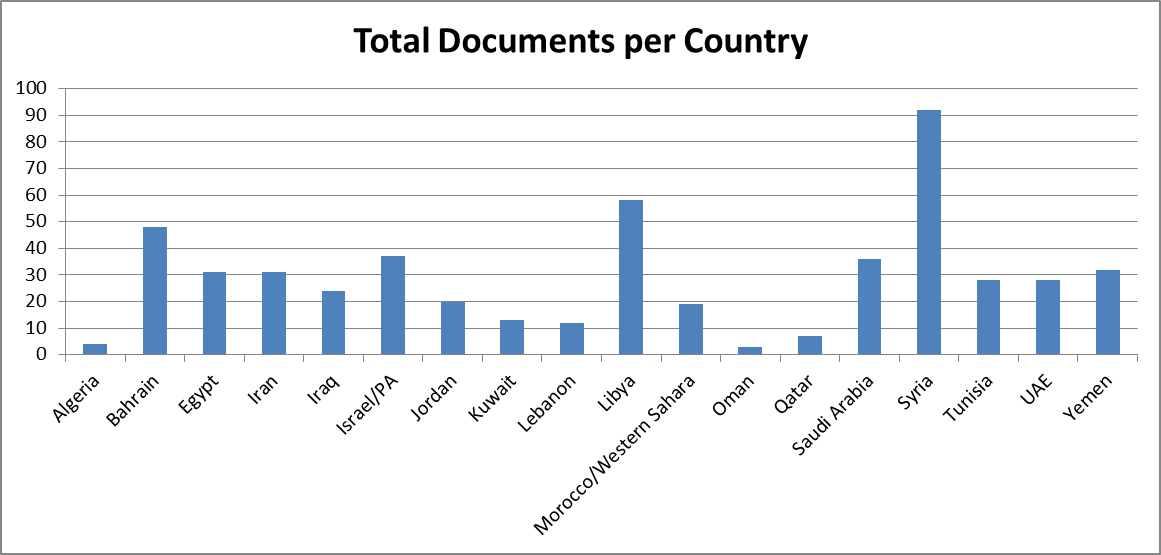
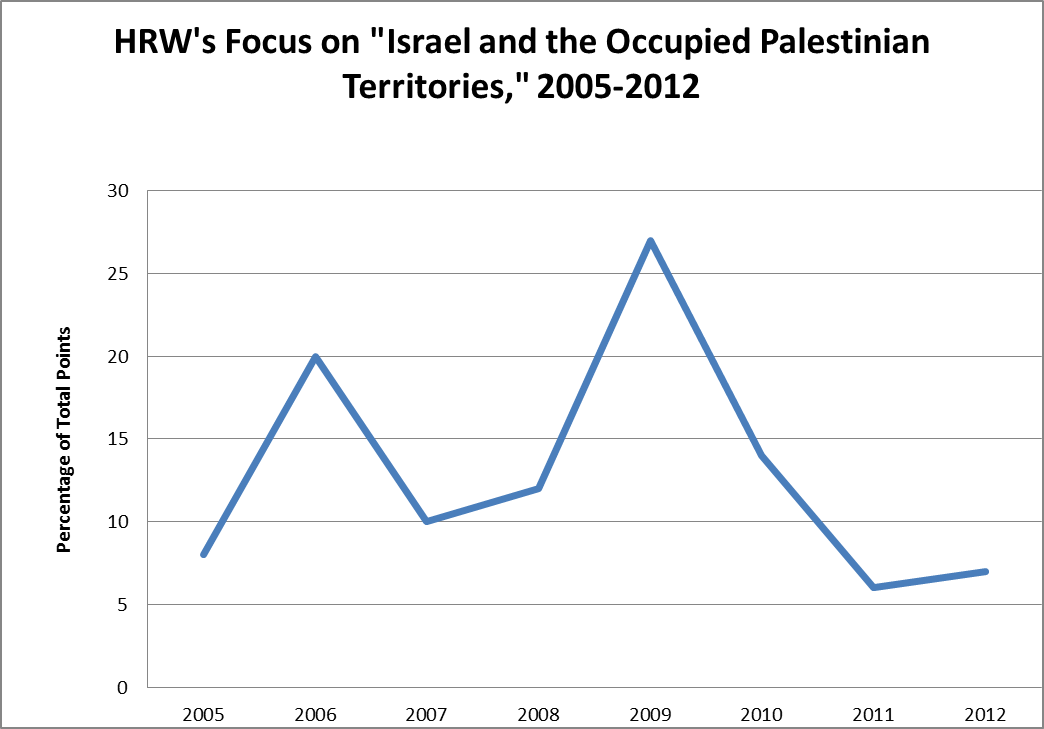
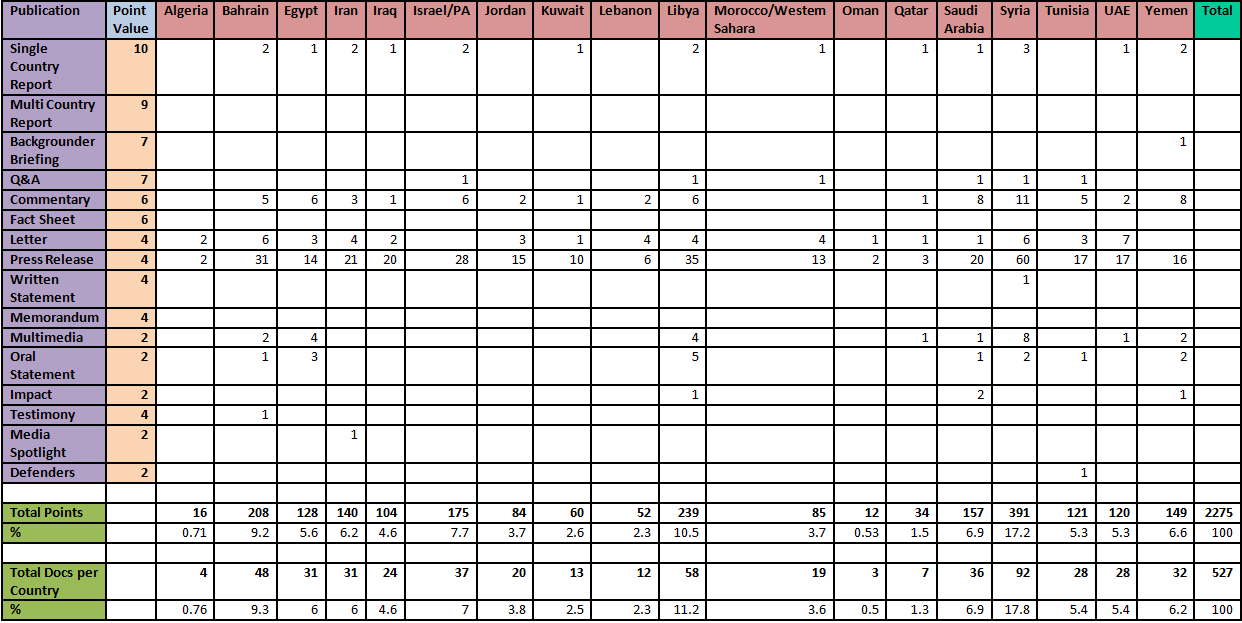
In 2012, HRW issued more reports, press releases, op-eds, and other publications on Syria (92), Libya (58), and Bahrain (48) than on other countries in MENA. Documents on “Israel and the Occupied Territories” [1] comprised 7% of the 2012 MENA total, slightly above last year’s percentage, 6.83, which was the lowest percentage since NGO Monitor’s annual analysis began in 2005.
However, “Israel and the Occupied Territories” (37) still received more coverage than Egypt (31), Iran (31), Tunisia (28), Lebanon (12), Iraq (24), and Yemen (32), and comparable attention to Saudi Arabia (36). In other words, criticizing Israel remains a higher priority for HRW than systematic repression in Iran, violence in Yemen, and the possibility of another autocratic regime in Egypt.
The 92 documents on Syria, in comparison to previous numbers on Israel, also demonstrate the disproportionate attention that was devoted to Israel. In 2009, HRW produced a slightly-greater number of documents (99) on Israel, including dozens of statements on the Gaza conflict and in support of the Goldstone Report. Yet, by all accounts, the civilian death toll in Syria in 2012 (60,000) was more than 60 times greater than the civilian death toll in Gaza in 2009. Additionally, in Syria, the Assad regime has been intentionally targeting the civilian population, in particular political and ethnic opponents, whereas the limited number of civilian deaths in Gaza was due to the operation of Hamas and other Palestinian combatants from within civilian areas and/or faulty intelligence.
Another indication of HRW’s partial attention to non-democratic repressive regimes in the Middle East is the lack of major reports on certain counties. A report on Algeria has not been published since 2008. Similarly, Oman has never been the exclusive focus of a detailed report, and in 2012, Oman was the subject of a press release for only the second time since 2008.
Weighted Analysis
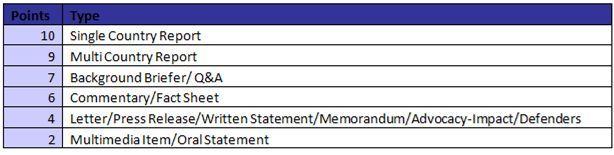
NGO Monitor’s weighted analysis, which reflects resource-consumption and relative impact (i.e., more effort goes into and more impact results from producing a report than a press release – see Appendix 2), shows that HRW devoted the most resources on Syria (391), followed by Libya (239), Bahrain (208), “Israel and the Occupied Territories” (175), Saudi Arabia (157), Yemen (149), and Iran (140). (See Table 2 for an overview; Appendix 3 for full results.)
Table 2 – Weighted Score for 2012 MENA Documents
.png)
In 2012, two full length reports were dedicated to “Israel and the Occupied Territories.” The first, “‘Forget About Him, He’s Not Here’: Israel’s Control of Palestinian Residency in the West Bank and Gaza,” February 5, 2012, made unsubstantiated claims that Israel was limiting residency permits to Palestinians in order to maintain “demographic control” over the Palestinian Authority, as well as unqualified assertions relating to Israeli security needs. The 110-page document was also accompanied by a media blitz, including a press conference at the American Colony Hotel in Jersualem. The second, the 43-page “Abusive System: Failures of Criminal Justice in Gaza,” October 3, 2012, is one of the few HRW reports on the Palestinians not to blame Israel for a given human rights concern. However, like its December 2012 press release on the rockets from Gaza, this report presented little new information and was issued more than five years after the Hamas takeover in Gaza. HRW offered no explanation as to why it took so long to issue this report despite the massive abuses occurring in Gaza since at least 2007.
In addition, MENA focused 50% of its press releases about “Israel and Occupied Territories” on criticism of Israel, 11% on both sides of the conflict, and 39% on human rights violations by the Palestinian Authority and Hamas. These figures represent a significant change from previous years, when HRW systematically ignored on intra-Palestinian violations.
Failing Closed Societies
In his 2009 New York Times op-ed, founder Robert Bernstein criticized HRW for “cast[ing] aside its important distinction between open and closed societies.” Indeed, this trend has continued.
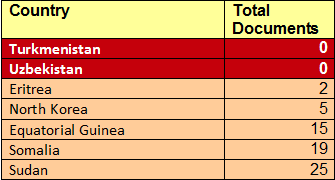
In 2012, Freedom House gave the lowest possible ranking for both political rights and civil liberties to seven countries outside the Middle East: Eritrea, Equatorial Guinea, North Korea, Somalia, Sudan, Turkmenistan, and Uzbekistan.
In sharp contrast, HRW entirely ignored two of these countries (Turkmenistan and Uzbekistan) in 2012, and none was the focus of more than 25 total documents. Israel, on the other hand, was the subject of 37 HRW documents in 2012.
Appendices
This section contains the data behind NGO Monitor’s report on Human Rights Watch’s activities in 2012.
Appendix 1: HRW Emphasis on “Israel and Occupied Territories” 2005 – 2012
Appendix 2: Measure of Effort
Appendix 3: Documents according to Country
Click to enlarge
Endnotes:
[1] This term follows HRW’s categorization.
2011
HRW in 2011: More Balance, Less Credibility, January 9, 2012
The Impact of the Arab Turmoil on HRW’s Middle East and North Africa Division
Summary:
- In 2011, HRW’s Middle East and North Africa Division (MENA) published 60% more documents than in 2010, with the majority relating to closed Arab societies involved in the turmoil and revolution. This represents a major increase over previous years, when HRW gave little attention to violations in closed, authoritarian regimes.
- In its reports on Libya, HRW sought to erase the NGO’s previous cooperation with the Qaddafi regime, including MENA Director Sarah Leah Whitson’s central role in marketing Saif al-Islam Qaddafi as a reformer. The lack of an independent investigation of ties between HRW and the Qaddafi regime continues to stain HRW’s reputation.
- HRW reduced its disproportionate focus on the Arab-Israeli conflict by issuing more reports, press releases, op-eds, and other publications on Libya, Egypt, Syria, Bahrain, and Yemen than on other countries in MENA. However, “Israel and the Occupied Territories” [1] still received more attention than Tunisia, Saudi Arabia, and Iraq.
- For the first year since 1995, in 2011 HRW did not publish a major report focusing on Israel. HRW also published an almost equal number of documents criticizing Israel and the Palestinians. At the same time, HRW’s bias on Israel continued. All op-eds on the Arab-Israeli conflict published in major international platforms focused on allegations against Israel.
- MENA Director Sarah Leah Whitson published an op-ed (April 15, 2011) in the Huffington Post exploiting the US Civil Rights Movement to vilify Israel as a racist state and race bait American Jews.
- In 2011, an alleged member of the PFLP terror organization, Shawan Jabarin, was appointed to the HRW Middle East Advisory Board.
- James F. Hoge Jr.’s appointment as Chairman of HRW’s Board has had no noticeable impact. In the Middle East and North Africa division (MENA), ideologues Sarah Leah Whitson and Joe Stork continue to control the agenda, at the expense of universal and credible promotion of universal human rights values.
**This report includes quantitative analyses of publications from HRW’s Middle East and North Africa section, using a weighted scale methodology consistent with NGO Monitor’s previous analyses.
Agenda Analysis:
As NGO Monitor has documented in annual reports on the activities and publications of Human Rights Watch (HRW), HRW’s Middle East and North Africa (MENA) division disproportionately focuses on Israel and maintains a deep institutional bias. For years, HRW continually neglected the most egregious and systematic abuses in closed Middle East societies, while using its resources for campaigns alleging Israeli violations.
In 2011, however, HRW issued more reports, press releases, op-eds, and other publications on Libya, Egypt, Syria, Bahrain, and Yemen than on the Arab-Israeli conflict, marking a major departure. The evidence suggests that this has merely been a response to greater media attention on protests and upheaval in Arab countries, and that the anti-Israel bias persists.
This is the first full year in which James F. Hoge Jr. has been responsible for HRW’s agenda as Chairman of the Board. As this report demonstrates, Mr. Hoge did not address HRW’s major deficiencies, particularly in the Middle East and North Africa division (MENA). The same ideologues – Sarah Leah Whitson and Joe Stork – continue to control the MENA agenda, at the expense of universal and credible promotion of universal human rights values.
Overview:
Since 2005, NGO Monitor has published quantitative analyses on the activities and publications of HRW’s MENA division. The results for 2011 show that MENA produced 60% more documents in 2011 than in 2010. Table 1 shows a breakdown by country of the documents produced by MENA in 2011:
Table 1 – Number of 2011 MENA Documents by Country
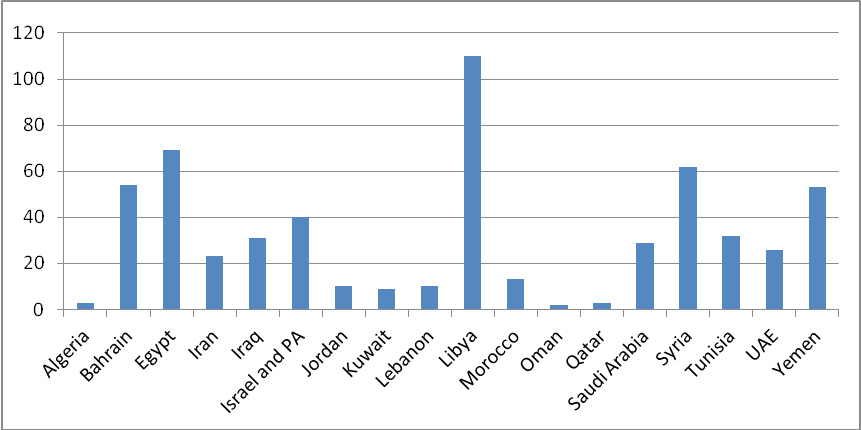
Documents focusing on “Israel and the Occupied Territories” represented 6.83% of the 2011 MENA total. This is the lowest percentage since NGO Monitor’s annual analysis began in 2005.
The Arab Upheaval Catches HRW by Surprise
The Middle East in 2011 was characterized by unprecedented turmoil, mass protests, and violence, leading to regime changes in Egypt, Libya, Tunisia, and Yemen. Other countries such as Bahrain and Syria also experienced mass protests and significant state-sponsored violence. In Syria, according to reports of local activists, more than 5,000 civilians have been killed.
Table 2 shows the top seven countries in terms of the total number of documents published by MENA in 2011. The top five countries in 2011 are those involved in the Arab Turmoil. Additionally, the comparative figures of 2010 make it clear that, previously, MENA had failed to focus significant attention on these countries.
Table 2 – Top Seven Countries by Total Documents
| Country | Total 2011 | Total 2010 | Change |
| Libya | 110 | 19 | +478% |
| Egypt | 69 | 34 | +103% |
| Syria | 62 | 12 | +416% |
| Bahrain | 54 | 18 | +200% |
| Yemen | 53 | 19 | +178% |
| Israel and PA | 40 | 51 | -22% |
| Tunisia | 32 | 18 | +78% |
Weighted Analysis
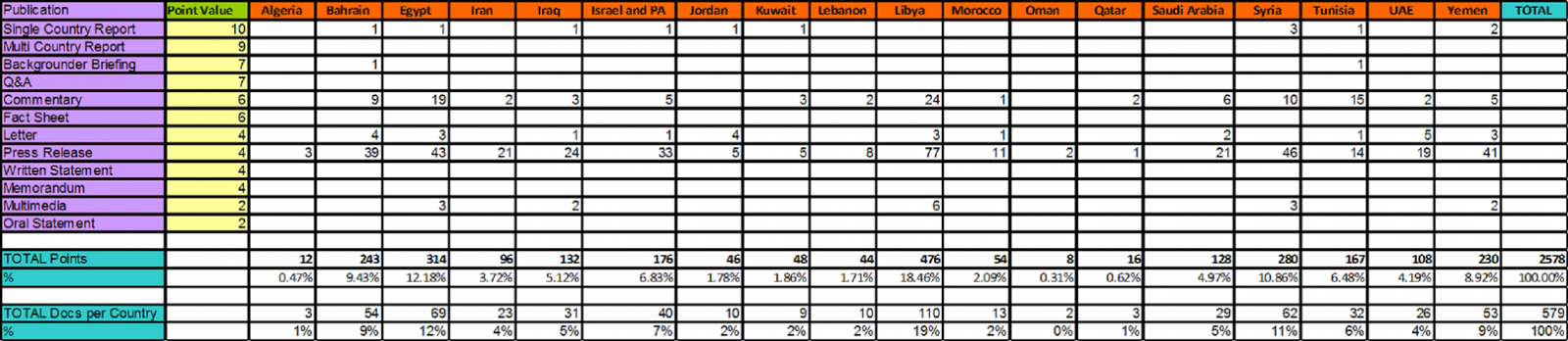
NGO Monitor employs a weighted methodology in analyzing the types of publications to reflect resource-consumption and relative impact (see Appendix 2). The weighted analysis reflects the fact that more effort goes into and more impact results from producing a report than a press release. This analysis demonstrates that MENA focused the most resources on Libya (476), followed by Egypt (314), Syria (280), Bahrain (243), Yemen (230), “Israel and the Occupied Territories” (176) and Tunisia (167). (See Table 3 for an overview; Appendix 3 for full results.)
Table 3 – Weighted Score for 2011 MENA Documents
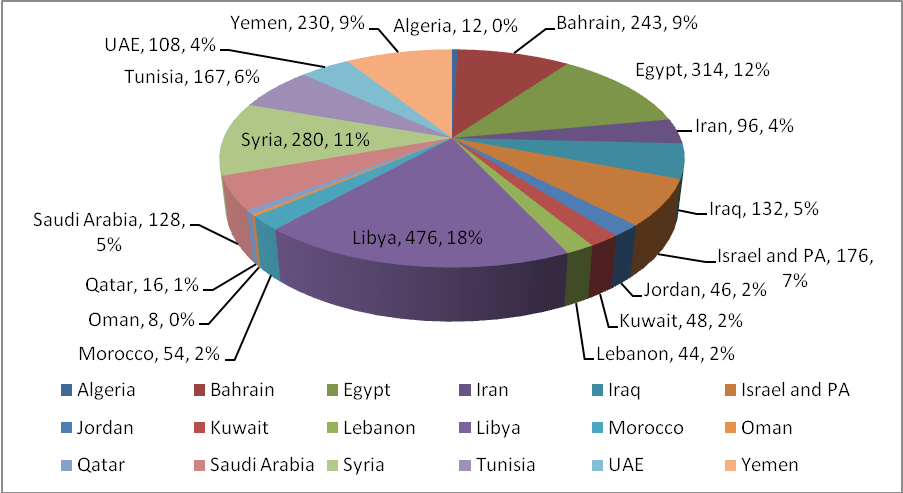
The results of the weighted analysis are consistent with the results of the quantitative analysis. One noteworthy result is the high score for Tunisia, reflecting the large number of “Commentaries” (i.e. opinion articles) that mention Tunisia as the catalyst for the Arab Turmoil.
The “Israel and the Occupied Territories” total mirrors the quantitative results and is the lowest since NGO Monitor began its weighted analysis in 2005.[2]
Yet Arab-Israeli issues still received more attention than Tunisia, Saudi Arabia, and Iraq, indicating that the shift in priorities is due to the high media profile of countries involved in the Arab Turmoil and not a deliberate decision to decrease focus on Israel. Additionally, the violence and human rights violations in the Arab authoritarian regimes were too massive to ignore, regardless of ideological preference.
Israel and the Occupied Territories – Content Analysis
NGO Monitor’s 2010 HRW report showed that 75% of all documents on “Israel and the Occupied Territories” focused on alleged abuses of human rights by Israel. In 2011, quantitatively, MENA published slightly more (51.6%) press releases focusing on alleged human right abuses by Palestinian actors.[3] Notably, the one report published in 2011 in the “Israel and Occupied Territories” category deals with abuses against journalists by Palestinian Security Forces. This marks the first time since 1995, that no full-length report focusing on Israel was published.[4]
However, when commentaries and the report are included, only 44% of the documents focused on human right abuses by the Palestinians. Still, this figure is a significant change from 2010 and previous years, in which HRW reports systematically ignored or focused very limited attention on Palestinian mass terror attacks and other violations.
This result may reflect the impact of NGO Monitor’s detailed analyses, and criticism from HRW founder Robert Bernstein and others, regarding its disproportionate focus on Israel and its one-sided approach to the Arab-Israeli conflict.
Separate but Unequal
Despite the movement towards restoration of the universality which is a foundation for human rights, and which has been violated by HRW and MENA in the past, the anti-Israel bias did not disappear in 2011. For instance, all five opinion pieces published in 2011 about “Israel and the Occupied Territories” focused solely on alleged violations by Israel. These op-eds, published in influential international media platforms such as The Guardian, Huffington Post, and Foreign Policy, reflect HRW’s continuing ideological targeting of Israel, under the façade of human rights claims.
The anti-Israel bias is further evident in a statement that immorally equated the intentional firing of an anti-tank missile at a school bus, killing a minor, with an Israeli attack targeting rocket launchers that accidentally injured two ambulance drivers (April 12, 2011). In a similar manner, HRW did not note that Palestinian rocket attacks were illegally fired at Israeli civilians (each one a war crime) when calling on Israel to “investigate recent attacks on Gaza causing civilian casualties and take all necessary steps to avoid civilian harm” (March 1, 2011).
MENA’s bias is occasionally more subtle. In a press release about the Palestinian Authority’s violent crackdown on peaceful protesters who were chanting “The people want an end to Oslo,” HRW explained that the protesters were “referring to the agreement that created the PA and gave Israel exclusive control over 60 percent of the West Bank.” This framing, related to the 1993 Declaration of Principles and subsequent agreements between Israel and the Palestinian Authority, simply repeated a biased political interpretation of this process, and ignored ongoing Palestinian rejectionism and opposition to peace with Israel in any form.
Likewise, in reporting on the deaths of Syrian demonstrators who had illegally breached the border with Israel on June 5, HRW wrote, “the following day, Syrian security forces shot and killed mourners at a funeral for one of the men killed by Israeli troops. Serious human rights violations by the Syrian government of course provide no justification for Israel’s unlawful use of lethal force.” The last sentence is superfluous and tendentious, serving to demonize Israel as equivalent to Syria.
Continued Institutional Bias
As noted in previous NGO Monitor analyses, prior to joining HRW, MENA Executive Director Sarah Leah Whitson was associated with the NGOs MADRE and the Center for Social and Economic Rights (CESR) and other anti-Israel activism. In an article about HRW’s bias in the Middle East (“Minority Report: Human Rights Watch fights a civil war over Israel,” The New Republic, April 27, 2010), Benjamin Birnbaum quotes a source stating that Whitson “definitely has no sympathy for the Israeli side” and that she has “a lot of personal identification with the Palestinian cause.”
On April 15, Whitson published an op-ed titled “A Matter of Civil Rights,” which framed the Arab-Israeli conflict as motivated by “Israeli racism.” Whitson’s op-ed repeated the words “segregate,” “race/racist,” “discrimination” and “equal/unequal” 23 times in an attempt to portray Israel as a racist state. In this article, American Jews were race baited by Whitson, who negatively compared their support for the U.S. civil rights movement to their support of Israel.
MENA further violated the moral standards required of human rights groups by appointing Shawan Jabarin – an alleged member of the PFLP terror group – to HRW’s Middle East Advisory Board. The Israeli Supreme Court has described Jabarin as “a Dr. Jekyll and Mr. Hyde, in part of his hours of activity he is the director of a human rights organisation, and in another part he is an activist in a terrorist organisation which does not shy away from acts of murder and attempted murder.” This appointment was heavily criticized in the media, with Stuart Rabinowitz – who had previously led fact finding missions for HRW – claiming that Jabarin’s biography and suspected membership in PFLP were withheld from the members of the Middle Ease Advisory Board by HRW’s Executive Director Kenneth Roth and MENA Director Sarah Leah Whitson. Rabinowitz stated that “the Jabarin incident, I believe, is part of a pattern of conduct that casts doubt about Mr. Roth’s and Ms. Whitson’s ability to deal with matters affecting Israel in a balanced and objective manner.”
In 2011, HRW once again demanded that the Israeli government lift the travel restrictions on Jabarin, while failing to mention the reason – his alleged membership in the PFLP, which has been repeatedly affirmed by the Israeli Supreme Court. Since 2007, HRW has issued three press releases dealing solely with Jabarin’s travel restriction, in addition to two letters to the Israeli government specifically about this issue. By comparison, kidnapped Israeli soldier Gilad Shalit was the main focus of only two press releases and was mentioned in a single letter during the over five years in which he was illegally held incommunicado by Hamas.
No Remorse: HRW’s Promotion of the Qaddafi Regime
Prior to the rebellion and overthrow of the Qaddafi regime, HRW’s MENA division had been deeply implicated in marketing a façade of reform. In 2009, MENA Director Sarah Leah Whitson authored an op-ed published in Foreign Policy headlined “Tripoli Spring,” and attributing improvements in human rights in Libya to Qaddafi’s son Saif al-Islam. On December 12, 2009, HRW held a news conference in Libya, under the auspices of Saif-Al Islam and the Qaddafi Foundation, as part of the campaign to market “Saif al-Islam’s reputation as a ‘reformer’,” according to a US state department memo.
The HRW 2011 World Report, published on January 24, 2011 stated that “The only organization able to criticize human rights violations publicly is the Human Rights Society of the Gaddafi Foundation, which is chaired by Saif al-Islam al-Gaddafi.”
As the revolt increased, in parallel to more images of brutality became public, HRW slowly revised its previous policies. Only on February 22, 2011, after the Qaddafi regime began to murder citizens protesting against the abusive regime, HRW’s Fred Abrahams referred to Saif al-Islam as “the so-called reformer son.” Just two days later (and exactly one month after the 2011 World Report), Whitson denounced Saif al-Islam, stating “Seif Islam in fact abandoned his nascent reform agenda long before the past week’s demonstrations.” Yet, Whitson had never made this claim before nor did she apologize for her earlier central role in the promotion of Saif al-Islam.
Further erasing HRW’s role in sustaining the Qaddafi regime’s façade of reform, HRW criticized, without any irony, other organizations as well as governments that had previously dealt with Saif al-Islam. In a further example of hypocrisy, HRW Business and Human Rights Director Arvind Ganesan condemned the London School of Economics (LSE) for allowing “Abusive and corrupt officials or their families to launder their images in exchange for money,” and stated that “the London School of Economics did not act until Saif al-Islam’s father literally began to kill his own people.” This is despite the fact that David Held, Co-Director of LSE Global Governance, had partially attributed his view of Saif al-Islam as a reformer to Whitson’s Foreign Policy article regarding her Libyan visit. Similarly, in an October press release, HRW wrote that “western governments’ apparent eagerness to embrace Gaddafi for his support on counterterrorism, as well as lucrative business opportunities, tempered their criticism of his human rights record in recent years.”
While HRW criticized the LSE for accepting funding from Saif al-Islam (quoted above), the LSE addressed the issue in an open, thorough and decisive manner. The Woolf report, entitled “An inquiry into the LSE’s links with Libya and lessons to be learned” (October 2011), investigated the process by which the LSE accepted funding from Libya and presented guidelines for preventing such an incident in the future. Saif al-Islam’s reputation as a reformer was cited in the Woolf report (though not directly attributed to HRW), as one of the factors leading to the LSE’s connections with Qaddafi’s Libya. To the best of our knowledge, HRW has not opened a similar investigation into their own role in the promotion of Saif al-Islam as a reformer, as well as any other contacts with the regime.
The Costs of HRW’s Neglect of Closed Societies
The media attention surrounding the Arab Turmoil caused HRW in 2011 to focus on dictatorships that in the past have had received scant attention. Notably, however, HRW in 2011 continued to ignore, or cover only minimally, closed societies with poor human rights records that did not receive similar levels of media attention.
For instance, HRW has no country page for Mauritania, a North African nation where slavery is still practiced. Similarly, a report on Algeria has not been published since 2008. In 2011, Oman was the subject of a press release for the first time since 2008. Similarly, Qatar had only one press release and two opinion pieces published – and all three focused on the plight of Eman al-Obeidy – a Libyan woman who was raped and fled to Qatar. Prior to this, there had not been a press release focusing exclusively on Qatar since 2003.
Moreover, neither Qatar nor Oman has ever been the exclusive focus of a detailed report.
The Absence of Credible Research Methodology
As previous NGO Monitor reports have demonstrated, HRW research, at least in the Middle East region, has lacked a credible methodology, and its reports are often based on unverifiable claims quoting unreliable sources. HRW statements often cite unnamed “eyewitnesses” whose veracity cannot be established. Furthermore, witnesses are not always interviewed in person, and are sometimes interviewed by people who lack any specialized training or using online messaging services. This use of unreliable sources led HRW Director Kenneth Roth to tweet about Syrian “blogger kidnapped by armed men. Had written on uprising, politics, being a lesbian,” who was actually an American man from Georgia.
In other instances, anonymous HRW “researchers” make medical and technological claims that require forensic testing and extensive expertise, based on visual observations. For instance, in an April 2011 press release, HRW claimed to be able to identify “shrapnel and entry and exit holes…that are consistent with an attack with a shell fired from the main gun of a tank.” In that same press release, HRW claimed to observe “injuries [that] are also consistent with small, cubic shrapnel from the drone-launched missiles that Human Rights Watch examined during the 2008-09 Gaza conflict.” (HRW’s statements about Israel’s alleged use of drone weapons in the Gaza War, which form the basis for the claims made in the press release, are themselves pure speculation and without evidentiary foundation.)
Conclusion: Rebuilding HRW’s MENA Division Remains Top Priority
In 2010, a HRW official stated that “We seek the limelight,” referring to their tendency to focus on issues such as Israel, that receive significant international media coverage. As shown in this report, in 2011, HRW’s long overdue focus on human rights in closed dictatorial societies in the Middle East can best be explained by the increased media profile of these regimes.
In this regard, HRW’s MENA division has yet to restore its credibility. Until there is an independent investigation and accounting of all ties between Sarah Leah Whitson and the Qaddafi regime, the stain on HRW’s record will color all reporting on the Middle East and beyond. Similarly, a change in the ideologically biased leadership of the MENA division is long overdue, as is the need for the implementation of consistent and credible research methodologies.
Appendices
This section contains the data behind NGO Monitor’s report on Human Rights Watch’s activities in 2011.
Appendix 1: HRW Emphasis on “Israel and Occupied Territories” 2005 – 2011
.png)
Appendix 2: Measure of Effort
Appendix 3: Documents according to Country
Click to enlarge
Endnotes:
[1] This term follows HRW’s categorization.
[2] HRW’s focus on Israel is evidenced by the fact that Hebrew is one of the nine languages in which the HRW website is available. The other languages: English, French, Turkish, Arabic, Chinese, Japanese, Spanish, Russian, and Dutch all represent significantly larger group of speakers.
[3] This did not count 2 press releases that focused equally on both sides.
[4] In 2003, a report called “The “Roadmap”: Repeating Oslo’s Human Rights Mistakes focused on both sides.
2010
HRW in 2010: More Bias, Even Less Credibility, January 6, 2011
Summary
- In 2010, as in previous years, Human Rights Watch’s Middle East and North Africa (MENA) division published more documents on “Israel and the Occupied Territories” than on any other country in the region. HRW produced 51 documents on “Israel and Occupied Territories,” followed by Iran (44), Egypt (34), Saudi Arabia (33), and Iraq (25).
- In 2010, journalists Benjamin Birnbaum (The New Republic) and Jonathan Foreman (Sunday Times [UK]) exposed HRW’s anti-Israel agenda, lack of credibility, and the ideological bias of HRW’s MENA staff. These publications reflected NGO Monitor’s detailed reports – see Experts or Ideologues: Systematic Analysis of Human Rights Watch (2009)
- HRW responded to the documented analysis and NGO Monitor’s requests for information by reducing transparency. In 2010, HRW removed their annual reports and the names of all employees, except for department heads, from its website.
- Systematic qualitative analysis by NGO Monitor demonstrates continued neglect of the most egregious and systematic abuses in closed societies (Saudi Arabia, Syria, Libya, Algeria, etc.). One of three major reports on Israel in 2010 consisted of166 pages, while ten years of research on human rights violations in Syria produced a 35-page report.
- HRW is heavily involved in the boycotts and sanctions campaigns targeting Israel, highlighting the politicized and biased agenda, as emphasized in the December 2010 publication “Separate and Unequal” – a title that falsely compared the conflict situation to the U.S. civil rights movement.
- MENA director Sarah Leah Whitson justified her meeting with the Hamas Minister of Justice as an effort “to listen to all parties directly so she will prepare more objective and impartial reports,” renewed her call for the Caterpillar boycott against Israel, and praised “the Lebanese sophistication for human rights.”
- In a November lecture, HRW founder Robert Bernstein expanded on his criticism of HRW for losing “critical perspective” on the Middle East conflict and “helping those who wish to turn Israel into a pariah state.” He noted that “little has changed” since the publication of his October 2009 op-ed in the New York Times.
Agenda Analysis: Israel remains major target; closed societies given less resources
Overview:
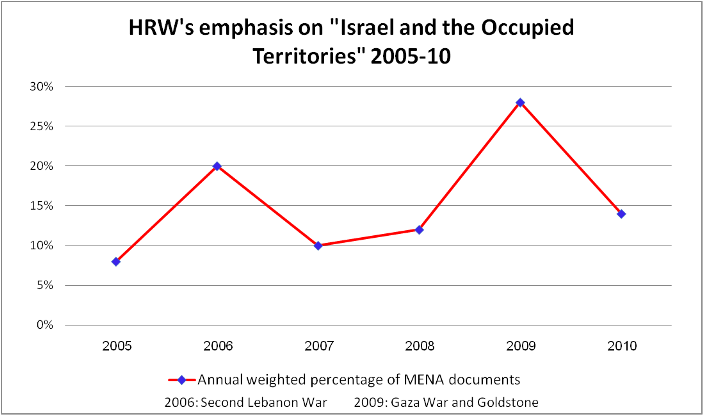
Since 2005, NGO Monitor has published quantitative analyses on the activities and publications of HRW’s Middle East and North Africa division (MENA). Comparing this data shows that the volume of HRW’s allegations directed at Israel are consistently and significantly above most other countries in the region. Periods characterized by major conflict (2006, 2009) lead to even greater disproportionality in the HRW condemnations of Israel, and these years are generally followed by a somewhat reduced emphasis on Israel, as was the case in 2007 and again in 2010 (see Appendix 1). The documents focusing on Israel continue to lead the HRW agenda for the region (see Table 1).
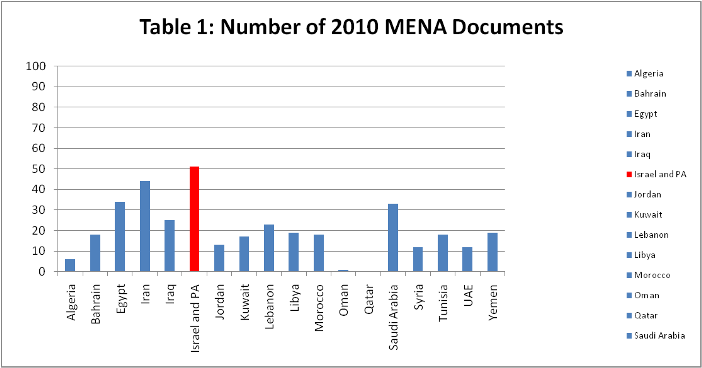
Detailed qualitative analysis of the content of HRW’s reports and press releases has also demonstrated a consisted ideological bias in the MENA division, and, as shown in the data, this continued in 2010. Under the direction of MENA director Sarah Leah Whitson, HRW places very limited emphasis on human rights violations in closed societies such as Saudi Arabia, Libya, Syria, Algeria, etc. In contrast, Whitson and deputy director Joe Stork have increased their involvement in BDS (boycotts, divestment, and sanctions) campaigns that target Israel.
Weighted Analysis — Disproportionate Focus on Israel
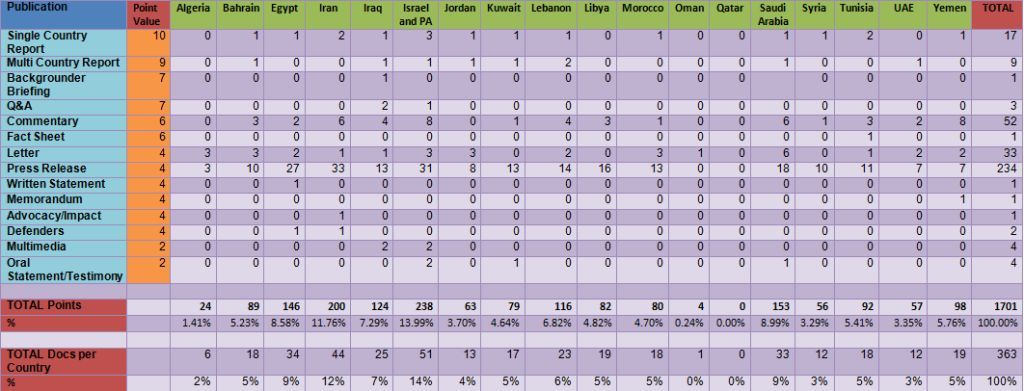
NGO Monitor employs a weighted methodology in analyzing the types of publications to reflect resource-consumption and relative impact (see Appendix 2). This analysis demonstrates that MENA focused the most resources on Israel (238 points), followed by Iran (200), Saudi Arabia (153), Egypt (146), Iraq (124), and Lebanon (116). (See Table 2 for an overview; Appendix 3 for full results.)
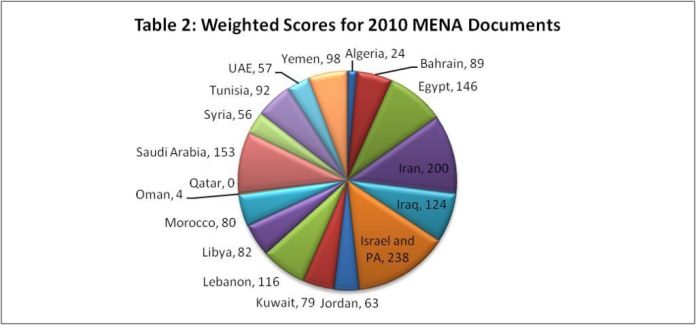
HRW publications on “Israel and the Occupied Territories” (HRW’s category) made up 14 percent of the total Mideast output in 2010. As noted, the 50 percent decrease (from 28 percent in 2009) reflects a reduction in armed violence in the region following the Gaza conflict, as well as reduced HRW lobbying on behalf of accusations made in the Goldstone Report, and increased external scrutiny of HRW by the media, NGO Monitor, and other experts.
Despite criticism of its biased agenda, including from HRW founder Robert Bernstein, the MENA division has not increased its relative de-emphasis on closed regimes where massive violations of human rights are a constant. Ten years of research on human rights violations in Syria produced a 35-page report; five years on Saudi Arabia resulted in a 52-page study (see below for substantive analysis of these reports). In contrast, HRW’s December 2010 report condemning Israel (“Separate and Unequal,”166 pages) is the longest report issued by MENA in the past two years (see below for detailed analysis). This disparity demonstrates the ongoing disproportionate allocation of research resources, and the intense over-emphasis on Israel.
In addition, HRW’s strategy of cursory publications on Syria, Libya, and Saudi Arabia contrast with the campaigns that target Israel, including the support for the Goldstone Report and recommendations. Similarly, in contrast to the narrow reports on Saudi Arabia, etc., HRW publications on Israel in 2010 covered a broad range of topics, including repeated accusations that Israel failed to adequately investigate the Gaza War and the “Free Gaza” flotilla incident. Other statements alleged discrimination against civil society, illegal demolition of Bedouin and Palestinian homes, and human rights violations in the West Bank and Gaza. A few documents noted Israel’s leadership in the Kimberly Process and in opposing “blood diamonds.”
In reports on Iran and Saudi Arabia, HRW focused on specific allegations of human rights abuses. In Iran, publications in 2010 dealt with post-election violence, and discrimination and violence against sexual minorities. Press releases addressed freedom of expression, women’s rights, religious freedom, sexual discrimination, and abuse of political prisoners. A number of statements condemned death penalty sentences.
Publications on Saudi Arabia dealt with domestic workers, political reform, individual instances of religious persecution, violations of freedom of expression and women’s and workers’ rights, and deportation of Somali migrants. The kingdom’s systematic violation of the most fundamental human rights was not a priority (see below for detailed analysis of HRW’s “soft approach” to Saudi Arabia).
HRW’s Ongoing Israel Obsession
As noted, HRW published more documents on Israel than on any other country in the MENA region, and the weighted analysis also demonstrated the primary focus on Israel. The number of items remained relatively constant throughout the year, with a minimum of two documents directed at Israel per month (see Table 3).
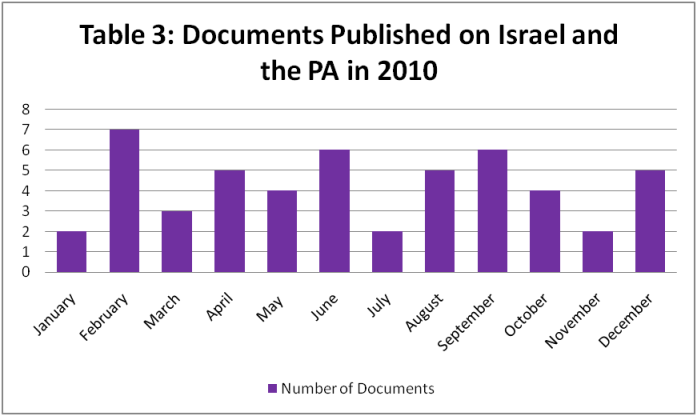
The majority of HRW documents on “Israel and the Occupied Territories” accuse Israel of human rights violations, while erasing the context of the conflict and the obligation of the Israeli government to protect its citizens from ongoing terror attacks. In 2010, HRW gave major attention to the alleged “inadequacy” of Israeli investigations into the Gaza War (14 of 51 documents) and the “Free Gaza” flotilla incident of May 2010 as part of the wider NGO campaign to discredit the Israeli justice system.
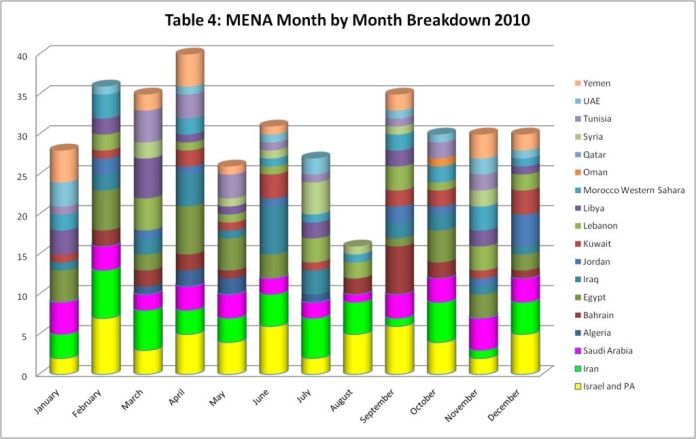
HRW also issued at least one document per month on Iran and Saudi Arabia (see Table 4).
In 2010, HRW issued three major publications on Israel – more than on any other Middle Eastern country. Two of the reports, “I Lost Everything” (May 13, 2010) and “Turning a Blind Eye” (April 10, 2010) contained additional allegations from the December 2008-January 2009 Gaza War (in addition to five HRW reports on the Gaza War in 2009).
The third report, “Separate and Unequal” (December 19, 2010), falsely accuses Israel of discrimination against Palestinians in the West Bank on the “basis of race, ethnicity, and national origin.” In it, HRW repeats previous demands of the U.S. government to sanction Israel by withholding security assistance “in an amount equivalent to [Israel’s] expenditures on settlements and related infrastructure in the West Bank.” These three reports were characterized by faulty methodology, reliance on unconfirmed NGO sources, and misrepresentations of international law.
HRW also increased its support for the BDS (boycotts, divestment, and sanctions) campaigns against Israel. At the news conference announcing the May 2010 “‘I Lost Everything’” report on the Gaza War, Sarah Leah Whitson renewed her call for the Caterpillar bulldozer boycott, which had been made in 2004 based on HRW’s “Razing Rafah” publication. Similarly, the “Separate and Unequal” report calls on corporations to sever ties with projects or companies in Israeli settlements. HRW MENA researcher Bill Van Esveld acknowledged HRW’s role in the campaign to delegitimize Israel: “It would be disingenuous for us to say it [“Separate and Unequal” report] has no similarities to BDS. This is kind of an S report” (referring to the S in BDS).
MENA’s anti-Israel bias was also seen on issues beyond the Arab-Israeli conflict. In 2010, HRW devoted a number of reports to the human rights abuse of migrant workers: “Walls at Every Turn” (October 6, 2010) examined extortion and sexual exploitation of migrant workers in Kuwait; “Slow Reform” (April 27, 2010) addressed the worldwide problem of violations against migrants, with an emphasis on Arab countries such as Saudi Arabia, Jordan, and the United Arab Emirates. “Rights on the Line” (December 11, 2010) again discussed the abuse of migrant workers internationally. However, when MENA researcher Bill Van Esveld wrote an op-ed about the topic, his article was entitled “Israel should Respect Rights of Migrant Workers” (Global Post, October 8, 2010), and did not mention other countries. Van Esveld’s two other op-eds in 2010 also dealt with the Arab-Israeli conflict.
HRW documents on Palestinian Authority and Hamas
Although HRW’s categories do not distinguish between Israel, the Palestinian Authority, and Hamas, NGO Monitor analysis shows that 13 of 51 (25%) documents on “Israel and the Occupied Territories” were directed primarily to the Palestinian Authority or Hamas. This constitutes a very small proportion, particularly considering the role of Hamas as a terrorist organization that commits major and systematic human rights violations targeting both Israelis and Palestinians.
In May 2010, HRW met with Hamas Minister of Justice Faraj al-Ghoul and other government officials, ostensibly to request permission to visit detainees in Gaza’s central prison. According to Hamas, at the meeting Whitson assured Alghoul that she was visiting Gaza “to listen to all parties directly so she will prepare more objective and impartial reports,” and appeased Hamas officials by promising that HRW’s next report would tackle Israeli settlements and allege Israeli violations of international law.
HRW’s bias was also seen in its approach to foreign aid. While demanding that the U.S. sanction Israel by “withholding [] funding from the Israeli government,” in response to the detention of a Palestinian blogger, HRW weakly stated, “Foreign donors should be asking the PA why it is allocating resources to arbitrarily detain a man for peacefully expressing his views.” In contrast to demands for anti-Israel sanctions, HRW repeatedly called for an end to the economic sanctioning of Hamas (which HRW refers to as “collective punishment”).
HRW’s statements in 2010 sporadically and belatedly condemned executions carried out by Hamas, the arbitrary closure of NGO offices in Gaza, and torture by PA Security Services. A press release (December 5, 2010) calling on the PA to free a detained blogger was only issued one month after his arrest, and following growing international pressure.
In addition, on June 25, 2010, HRW released a statement marking the fourth year of kidnapped Israeli soldier Gilad Shalit’s captivity. Although HRW accuses Hamas of “cruel and inhuman [that] may amount to torture,” the press release immorally compares Hamas’ detention of Shalit with Israel’s policies toward Palestinian detainees. As part of its political agenda, HRW continued to invoke international legal rhetoric such as including accusations that Israel was responsible for “unlawful collective punishment against Gaza’s civilians.”
Open vs. Closed Societies
The disparity in scope and harshness between reports on Israel versus abusive regimes in the Mideast is symptomatic of the differences in HRW’s approach to open and closed societies. HRW’s disproportionate coverage of Israel reflects the organization’s ideological bias that understates the chronic abuses of closed societies, while simultaneously targeting Israel – the only democratic country in the Middle East. This approach belies the universality of human rights and contributes to the global anti-Israel de-legitimization agenda.
Closed societies such as Saudi Arabia and Syria prevent access from without and criticism from within, limiting HRW’s ability to probe systematic human rights abuses. In contrast, the open and democratic nature of Israel enables HRW’s obsessive criticism and advocacy.
MENA’s soft approach to closed societies is clearly illustrated in “Looser Rein, Uncertain Gain,” HRW’s assessment of five years of reform in Saudi Arabia. The report downplays the most egregious examples of Saudi Arabia’s systematic abuse of human rights, such as the absence of sexual freedom, corruption and lack of government transparency, and religious persecution, and makes amorphous recommendations without concrete guidelines for implementation.
However, it is interesting to note that HRW officials outside MENA do not share the weak agenda on Saudi Arabia. In December 2010, HRW’s Deputy Washington Director Maria McFarland briefed the US House of Representatives on the subject of religious freedom in Saudi Arabia, describing a reality of severe religious repression, and systematic discrimination and persecution on the basis of religion. She also criticized U.S. inaction: “If the United States is serious about promoting religious tolerance in Saudi Arabia, it cannot remain content to publish a report once a year about religious repression or to praise Saudi Arabia for symbolic commitments to religious tolerance.” Ironically, MacFarland’s description of inadequate U.S. attention to Saudi Arabian abuses aptly applies to MENA’s work on Saudi Arabia.
HRW’s strategy of developing ties with totalitarian regimes, rather than combating serious human rights abuses, is led by MENA director Sarah Leah Whitson. Her influence in advancing this approach is evidenced in an op-ed she wrote following her visit to Libya (“Postcard from . . . Tripoli,” Foreign Policy in Focus, Feb 11, 2010). Although HRW’s Libyan press conference was cut short by government agents and ended in “pandemonium,” Whitson spun her trip and the event in an entirely positive light.
Whitson also met with Hamas Minister of Justice Faraj Alghoul in May 2010. At the meeting, Whitson assured Alghoul that she was visiting Gaza “to listen to all parties directly so she will prepare more objective and impartial reports,” and appeased Hamas by promising that HRW’s next report would tackle Israeli settlements and allege Israeli violations of international law.
At the end of November 2010, HRW staff and international committee members, including Whitson, traveled to Lebanon to discuss human rights reform in the country. Whitson praised “the Lebanese sophistication for human rights.” But, HRW Lebanon Director Nadim Houry condemned the lack of effectual and accountable state institutions, the absence of political will to implement change, and the problems created by the country’s political confessionalism.
In some instances, MENA does not report at all on violations in certain closed societies. For instance, HRW does not cover Mauritania, a North African country where it is estimated that more than 600,000 people are enslaved. HRW’s only publication documenting the repression of Mauritania’s black population by Arab rulers dates back to 1994.
HRW Hides from Media Criticism
In 2010, HRW demonstrated a continuing lack of credibility on Arab-Israeli issues. This was demonstrated in 2010 by journalists Benjamin Birnbaum and Jonathan Foreman, who published detailed research exposing HRW’s disproportionate focus on Israel, inconsistencies and lack of reliability in the organization’s research, and the ideological bias of HRW’s Middle East staff. The details presented in their articles reinforced NGO Monitor’s systematic research on these problems – see Experts or Ideologues: Systematic Analysis of Human Rights Watch (2009).
HRW responded to this documented analysis and NGO Monitor’s requests for information on the professional qualifications of various “researchers” by reducing transparency. In 2010, HRW removed their annual reports and the names of all employees, except for department heads, from its website.
Foreman’s “Nazi Scandal engulfs Human Rights Watch” (Sunday Times [UK], March 28, 2010) illustrated how the revelation of HRW “senior military analyst” Marc Garlasco’s Nazi memorabilia obsession was indicative of far deeper problems at the organization. The following excerpts from the article shed light on the MENA division:
- I interviewed a human-rights expert at a competing organisation in Washington… He told me he was “not surprised” that HRW has still not produced a report on the violence in Iran: “Their hearts are not in it. Let’s face it, the thing that really excites them is Israel.”
- Associates of Garlasco have told me that there had long been tensions between Garlasco and HRW’s Middle East Division in New York – perhaps because he sometimes stuck his neck out and did not follow the HRW line. Garlasco himself apparently resented what he felt was pressure to sex up claims of Israeli violations of laws of war in Gaza and Lebanon, or to stick by initial assessments even when they turned out to be incorrect.
- “While it may be hard to find people who are genuinely neutral about Middle East politics, theoretically an organisation like HRW would not select as its researchers people who are so evidently on one side.
On April 4, 2010, the Sunday Times published HRW’s response, which simply repeated claims that their coverage of other human rights abuses and conflicts is broader than the article implied. The correction, however, avoided the main issues such as credibility, bias against Israel, and the Garlasco gag order.
Birnbaum’s April 27, 2010 article in The New Republic, “Minority Report: Human Rights Watch fights a civil war over Israel,” similarly highlighted the deeply-rooted bias among senior HRW officials, in contradistinction to human rights principles. Excerpts from Birnbaum’s interviews with HRW staff and former HRW board members revealed the deeply rooted bias in the MENA division:
- MENA director Sarah Leah Whitson “definitely has no sympathy for the Israeli side… And she does, I think, have a lot of personal identification with the Palestinian cause,” according to a colleague.
- “It seemed to me that there was a commitment to a point of view—that Israel’s the bad guy here.
- “We seek the limelight—that’s part of what we do. And so, Israel’s sort of like low-hanging fruit.”
- “An organization that was founded to protect the most basic of human rights—freedom of speech… seems to have created within its own organization a disregard and intolerance for open dialogue.”
HRW board member emeritus and co-chair of the MENA committee Kathleen Peratis responded to the TNR article, repeating the claim (without evidence) that “There is no bias against Israel at Human Rights Watch except in the minds of those who erroneously believe Israel is harmed by honest criticism. Far from harming it, I believe this work strengthens Israel.” Peratis’ broad claim does not address any of the substantive questions about HRW’s bias and lack of credibility raised by Birnbaum, NGO Monitor, and others.
(For more details, see NGO Monitor’s analyses of the TNR and Sunday Times articles.)
Bernstein’s Continued Criticism of HRW
On November 10, 2010, HRW founder Robert Bernstein expanded his criticism of HRW at the Goldstein Lecture on Human Rights at the University of Nebraska at Omaha. He demonstrated that HRW and other human rights organizations are leading a political war against Israel by working closely with corrupt UN frameworks. Excerpts from the speech:
- “HRW and others have taken positions on the Wall, the borders, and the occupation, so it is hard to separate human rights issues from political issues… in their attempts to do what they think is evenhanded, they fail to recognize the virtues of nations that have had considerable success in making the Universal Declaration of Human Rights truly universal.”
- “HRW has been, by far, the biggest supporter of the UN Council, urging them to bring war crimes allegations against Israel – based on this [the Goldstone] report.”
- “I don’t believe HRW has responded to many responsible analyses challenging the war crimes accusations made by Goldstone and also challenging HRW’s own reports…”
- “the UN Human Rights [Council]… got the idea that they could get prominent Jews known for their anti-Israel views to head their investigations. Even before Richard Goldstone, they appointed Richard Falk… to be the UN rapporteur for the West Bank and Gaza. Richard Falk had written an article comparing Israel’s treatment of Palestinians in the West Bank and Gaza to Hitler’s treatment of the Jews in the Holocaust. Israel… would not allow him into the country. HRW leapt to his defense, putting out a press release comparing Israel with North Korea and Burma in not cooperating with the UN… the release was written by Joe Stork – Deputy Director of Human Rights Watch Middle East Division – whose previous job for many, many years, was as an editor of a pro-Palestinian newsletter.”
HRW’s Donors Respond
According to HRW’s Financial Statements, the organization lost $6 million in donor support in 2010. This can be attributed in part to responses to the May 2009 fundraising trip to Saudi Arabia and the revelation that HRW “senior military analyst” Marc Garlasco was an avid collector of Nazi memorabilia.
However, this loss was mitigated by a 10-year, $100 million donation from billionaire George Soros. The grant is the largest that Soros has ever made to an NGO. With the grant, HRW announced plans to increase its staff by one-third and “to shape the foreign policies of these emerging powers, much as we have traditionally done with Western powers.” While Soros’ gift will alleviate HRW’s declining income, it will not restore the NGO’s credibility on Israel.
HRW also altered the language on the “Financials” page of its website to reflect heightened scrutiny of its donors. In 2009, NGO Monitor revealed that Oxfam Novib, one of HRW’s major donors ($987,818 in 2007-8), annually receives nearly €130 million from the Dutch government. Subsequently, HRW added the claim that “Some foundations that support Human Rights Watch are partially funded by governments; we accept no government funds from these foundations, only privately sourced revenues.” HRW’s assertion cannot be independently verified, and given that the Netherlands provides over 70 percent of Oxfam Novib’s annual budget, it appears unlikely. (Numbers for 2009-2010 cannot be verified because HRW has not published the full version of their financial statements online.)
Additionally, a press release announcing the launch of its first Middle East Committee in Beirut (“Lebanon: Human Rights Watch Launches First Middle East Committee in Beirut,” December 6, 2010) also emphasized that the organization was “supported by contributions from private individuals and foundations worldwide. It accepts no government funds, directly or indirectly.”
HRW’s New Chair
In October 2010, James Hoge Jr. became the chair of HRW’s board, replacing Jane Olsen. As the longtime editor of Foreign Affairs, Hoge’s essays included the “Tiananmen Papers,” covering the brutal response of the Chinese government to the 1989 protests. It was hoped that under the new chair, HRW would devote more resources to substantively addressing severe, global cases of human rights abuses. (See NGO Monitor’s open letter, calling on Hoge to restore HRW’s moral leadership.)
Conclusion
For the past decade, HRW has played a major role in the destruction of the moral and universal foundations of human rights, and the exploitation of these principles for ideological objectives, particularly in the MENA division. The leaders of this organization have systematically ignored the criticism of these practices and abuses, and expanded their disproportionate attacks on democracies in general, and Israel in particular.
In November 2010, HRW founder Robert Bernstein delivered the Goldstein Lecture on Human Rights at the University of Nebraska at Omaha, in which he severely criticized HRW’s role in targeting Israel as one of the “principal offenders” of human rights. Bernstein call on HRW to return to its “founding mission and the spirit of humility that animated it.”
Perhaps under the leadership of James Hoge Jr., HRW will put its house in order, beginning with necessary changes at MENA. Without such changes, the organization will continue to fail those who most need the human rights advocates.
Appendices
This section contains the data behind NGO Monitor’s report on Human Rights Watch’s activities in 2010.
Appendix 1: HRW Emphasis on “Israel and Occupied Territories” 2005 – 2010
Appendix 2: Measure of Effort
The weighted values used in this report were calculated via the point system described below.
Points were allocated based on the level of resources required for HRW to publish that type of document, and the expected impact of that item.
Appendix 3: Documents according to Country
2009
Obsession and Scandals: HRW in 2009, January 5, 2010
Summary
- Human Rights Watch publications on “Israel and the OPT” comprised 28 percent of its total Mideast output in 2009. Israel received more attention than Iran, Saudi Arabia, Libya, Syria, and other chronic human rights abusers.[1]
- HRW allocated a disproportionate amount of resources to promoting the UN “fact-finding” mission of former board member Richard Goldstone, including statements in support of UN resolutions that condemned Israel. The 34 pro-Goldstone publications out-numbered documents on all the countries in the Middle East, except Israel and Iran.
- Scandals included a fundraising trip to Saudi Arabia, which used HRW’s anti-Israel bias and the specter of the pro-Israel lobby to solicit funds from “prominent members of Saudi society.”
- The revelation that Marc Garlasco, “senior military analyst,” is an avid collector of Nazi memorabilia casts serious doubt on HRW’s credibility and demands a close reexamination of his work for the organization.
- In a New York Times op-ed, HRW founder Robert Bernstein strongly criticized the organization for its anti-Israel bias and for ignoring severe human rights violations in closed societies.
- HRW has taken no action to implement Bernstein’s call to “resurrect itself as a moral force in the Middle East,” or the call from NGO Monitor’s International Advisory Board (including Elie Wiesel and Alan Dershowitz) to “institute a full independent review and reform in the organization.”
- In every instance of scandal and criticism, HRW officials (Roth, Levine, Whitson, etc.) responded with ad hominem attacks and ignored the substance.
Overview
In July 2009, Sarah Leah Whitson, director of the Human Rights Watch Middle East North Africa(MENA) division, explained HRW’s conception of the Middle East:
“In terms of the major human rights concerns in the Middle East I would break them down into two categories … . On the one hand, there’s the general absence of the most basic human rights throughout the Arab world and Iran. And on the other hand … are the ongoing Israeli occupation of the [Palestinian] territories … as well as Israel’s wars in the region… . There’s a vastly discriminatory system of laws and policies in place that create a system of apartheid under any legal definition.” (emphasis added)
Beyond the ideological distortion inherent in Whitson’s words, an analysis of HRW’s activities in 2009 reflects, as it has in the past, disproportionate attention to the Arab-Israeli conflict: close to 30 percent of HRW publications in the MENA division concerned “Israel and the Occupied Territories.”
In addition to the disproportionate focus on Israel, HRW devoted significant resources to attacking critics and minimizing controversies within the organization, including:
- its disproportionate allocation of resources on the Gaza war;
- its promotion of former HRW board member Richard Goldstone in his UN “fact-finding” mission, including an inordinate number of statements in support of the Goldstone Report and UN resolutions that condemned Israel;
- a fundraising trip to Saudi Arabia led by “senior members” of the organization, including Whitson;
- the revelation that HRW “senior military analyst” Marc Garlasco, who wrote numerous reports on Israel, is an obsessive collector of Nazi memorabilia;
- exposure of the ideological biases of Whitson and MENA Deputy Director Joe Stork;
- a New York Times op-ed by HRW founder Robert Bernstein criticizing the organization for its anti-Israel bias and for ignoring severe human rights violations in closed societies.
I. Agenda Analysis: Obsessive Focus on “Israel and the Occupied Territories”
Overview
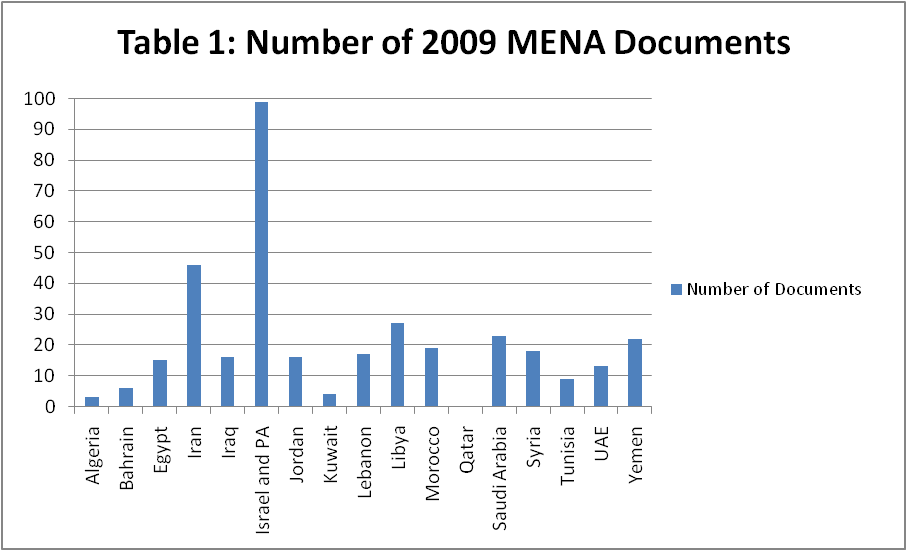
In 2009, HRW’s Middle East coverage reflected a pronounced and disproportionate focus on Israel (see Table 1). Analysis of the number of documents published by HRW on MENA countries in 2009 reinforces founder Robert Bernstein’s conclusion that “in recent years Human Rights Watch has written far more condemnations of Israel for violations of international law than of any other country in the region.”
Weighted for Resource Consumption and Impact
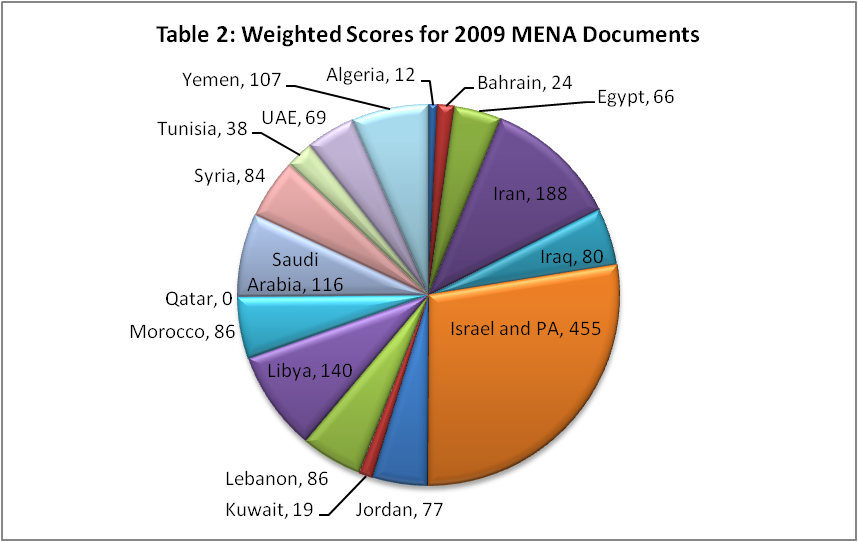
NGO Monitor also employs a weighted methodology in analyzing the types of publications to reflect resource consumption and relative impact (see Appendix 1). This analysis found that HRW focused most on Israel (455 points), followed by Iran (188), Libya (140), Saudi Arabia (116), Morocco (86), Syria (84), and Iraq (80). (See Table 2 for an overview; Appendix 2 for full results.)
Using this analysis, HRW publications on “Israel and the OPT” comprised 28 percent of the total Mideast output in 2009. This is an increase from 18 percent in 2008 and 15 percent in 2007, and matches the 2006 distribution (28 percent) based on HRW’s campaigns related to the Lebanon conflict. Israel’s score is higher than those of Iran, Libya, and Saudi Arabia combined.
Focus on Israel
The majority of HRW documents on “Israel and the OPT” describe alleged Israeli violations, with a heavy emphasis on accusations of misconduct during the Gaza war and HRW’s promotion of the Goldstone Report.
The number of items peaked in January during the Gaza conflict. In March and August, there were increases due to the release of reports alleging Israeli abuses during the war (Rain of Fire and White Flag Deaths). In the latter part of the year, HRW almost exclusively focused on advocating for the Goldstone Mission and Report (see Table 3).
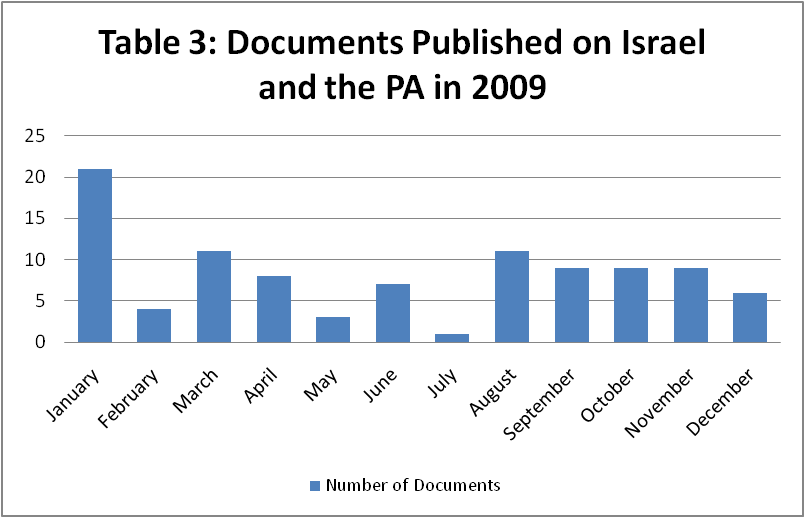
The five extensive HRW reports on Israel and the Palestinian Authority in 2009 were accompanied by public-relations campaigns that included press releases and multimedia items designed to amplify the content and messages of the reports. Nearly 50 percent of the featured multimedia items on MENA countries are about Israel.[3] The combined length of the three reports targeting Israel (173 pages; Rain of Fire, Precisely Wrong, White Flag Deaths) is significantly greater than the two reports describing Hamas violations (57 pages; Under Cover of War, Rockets from Gaza). This allocation of research resources also reflects the disproportionate focus.
II. HRW and the Gaza War
Israel’s military operation in Gaza, launched in response to ongoing rocket attacks on its civilians, began on December 27, 2008 and lasted for three weeks. During this period, HRW issued at least 20 statements (one per day), almost all condemning Israeli actions as “violations” of international humanitarian law.
As in previous regional conflicts, HRW’s approach was to remove the context of terror and aggression in order to sharpen the perception of Israel as acting illegally. For instance, in an op-ed in Forbes, HRW Executive Director Kenneth Roth made the accusation that Israel acted with “a determination to make Gazans suffer for the presence of Hamas – a prohibited purpose for using military force.” He provided no evidence for this far-reaching allegation.
The output of HRW documents peaked during the fighting, but attention on the Gaza war did not subside throughout 2009. Between March and August 2009, HRW issued five major reports on the Gaza conflict (out of 21 total reports in the MENA division in all of 2009). These reports were inconsistent, applied questionable methodology,[4] and utilized evidence selectively to fit HRW’s agenda.
Charges related to white phosphorus (Rain of Fire) and “white flag” deaths drove a variety of NGO campaigns during the Gaza war, following the model of the “massacre” claims about Jenin in 2002 and Qana in the 2006 Lebanon war.
Rain of Fire (March 25, 2009), written by Marc Garlasco and four co-authors, was accompanied by a press conference and numerous media interviews. The report relied on Garlasco’s “military expertise” and on entirely unverifiable and often inconsistent Palestinian “testimony.” To make their case, as in the past, the HRW authors distorted or ignored evidence inconsistent with their pre-formed conclusions. Another Garlasco report, Precisely Wrong (June 2009), which alleges Israeli “war crimes” through the use of drones in Gaza, was similarly flawed. In response, a number of experts unconnected with HRW immediately noted the major technical errors in Garlasco’s claims. Yet HRW refused to issue retractions or correct the record.
The single HRW report on Palestinian violations of Israeli human rights during the war, Rockets from Gaza, was not published until August 6, 2009, long after media attention had subsided.[5] This report covers no new ground and largely repeats the International Crisis Group’s report of April 2009. Moreover, the content of the report equates Israel with Hamas, fails to condemn Hamas for the use of human shields, and blames Israel for Hamas rocket fire from populated areas. Rockets from Gaza also ignores weapons smuggling into Gaza, as well as the role of Iran in supplying those weapons. In contrast to the condemnations HRW directed at Israel, its report on Hamas included no implications, and appears to be merely an attempt to create an artificial show of “balance.”
This report was followed one week later by another HRW report headlined White Flag Deaths, alleging that Israel deliberately killed civilians waving white flags. White Flags relied on conflicting Palestinian claims and reflected major discrepancies in Arabic-language and international media. Inconsistencies include whether Hamas fighters were present; the specific details of how the incidents transpired; and the number of casualties.. Reflecting the absence of credible evidence in the report, HRW was widely criticized. In response, HRW issued a press release, “False Allegations about Human Rights Watch’s Latest Gaza Report” (August 14, 2009), that claimed “Israeli officials are trying to discredit the report and Human Rights Watch by making false allegations.”
III. Goldstone
The extensive HRW activity on the Gaza conflict fed directly into the Goldstone Report, which was created by the UN Human Rights Council following intense lobbying by the Organization of the Islamic Conference, the Arab League, HRW, and the NGO network. (Judge Richard Goldstone was an HRW board member at the time of his appointment, and resigned due to the obvious conflict of interest.)
After Goldstone issued his report on September 15, 2009, HRW sought to gain support for the publication, releasing at least 12 statements in the following month. HRW repeatedly and obsessively pressed for the adoption of the recommendations and conclusions of the Goldstone Report, comparing the Gaza War to genocide and the mass atrocities in Darfur and the Congo. In this effort, HRW aligned itself with human rights stalwarts such as China, Saudi Arabia, and Libya.
The report copied many of HRW’s allegations, followed its “methodology” of reliance on Palestinian witnesses and evidence that could not be verified, and utilized HRW’s strategy of minimal criticism of Hamas in order to claim balance. Given that the credibility of HRW’s reports hinged on the endorsement of the Goldstone Report, HRW’s lobbying amounted to self-promotion.
Table 4 provides a comparative perspective on resources HRW devoted to backing the Goldstone Report. In total, HRW produced 34 documents on the Goldstone Report, an amount that surpasses the number of publications on the majority of countries in the MENA region including Libya, Saudi Arabia, Egypt, the UAE, and others. Twenty-three HRW publications addressed the post-election crisis in Iran.[6]

IV. HRW Attacks its Critics
In 2009, HRW faced many organizational scandals and unprecedented criticism. Instead of addressing the substance of the criticism, officials invested heavily in ad hominem attacks to discredit NGO Monitor, Robert Bernstein, and other critics. For instance, Sarah Leah Whitson told the Jerusalem Post (July 16, 2009), “The Gerald Steinbergs of this world, and I guess now the Sharanskys of this world, love to give blanket denials, love to give blanket dismissals.”
HRW Program Director Iain Levine attributed the criticism to “[a] conspiracy … [an] organized campaign, and … coordinated attacks” (November 13, 2009). He further complained, “We are having to spend a lot of time repudiating the lies, the falsehoods, the misinformation.” Levine could not provide any examples of inaccuracies in NGO Monitor’s reports.
HRW in Saudi Arabia
Although HRW acknowledges that Saudi Arabia is one of the worst violators of human rights, in May 2009 HRW officials visited Saudi Arabia to raise funds. The Arab News reported that “senior members” of HRW – including Whitson and Hassan Elmasry, a member of the International Board of Directors and the MENA Division’s Advisory Committee – attended a “welcoming dinner” and encouraged “prominent members of Saudi society” to finance their work. The Arab News article cited HRW’s focus on Israel as the major reason for seeking Saudi funding: “The group is facing a shortage of funds because of the global financial crisis and the work on Israel and Gaza, which depleted HRW’s budget for the region.”
Whitson’s appeal for Saudi money acknowledged and cited HRW’s anti-Israel focus: “Human Rights Watch provided the international community with evidence of Israel using white phosphorus and launching systematic destructive attacks on civilian targets.” Whitson boasted that this “evidence” was instrumental in the UN’s “fact-finding mission to investigate the allegations of serious Israeli violations during the war on Gaza.” (The mission was headed by Justice Richard Goldstone, a member of HRW’s board at the time of his appointment.)
In pitching HRW to the Saudis, Whitson also invoked the canard of “pro-Israel pressure groups,” which, she declared, “strongly resisted the report and tried to discredit it.”
The fundraising trip was initially exposed in an NGO Monitor blog post, and then publicized by George Mason University Professor (and Volokh Conspiracy blogger) David Bernstein in a Wall Street Journal op-ed.
HRW Defense of the Saudi Trip
The public exposure of the Saudi Arabia fundraiser generated widespread criticism. In addition to NGO Monitor and Bernstein, critics included Jeffrey Goldberg (Atlantic) and Noah Pollak (Commentary). In response, HRW officials evaded the central issue – that the organization sacrificed human rights principles in seeking money from the Saudis and played up its attacks on Israel to appeal to Saudi prejudices. The facts in the Arab News story were not disputed, and HRW did not produce any documents, such as a copy of Whitson’s remarks or PowerPoint at the dinner, to refute the charges. HRW did, however, attempt to divert attention from the main criticisms by leveling accusations of “racism” and denying that HRW ignores Saudi human rights violations.
In correspondence with Goldberg, Roth accused critics of “lies and obfuscation.” Only after repeated questioning did Roth acknowledge: “It wasn’t a pitch against the Israel lobby per se. Our standard spiel is to describe our work in the region. Telling the Israel story – part of that pitch – is in part telling about the lies and obfuscation that are inevitably thrown our way.” HRW’s defense also included an irrelevant and non-substantive attack on NGO Monitor: “NGO Monitor … conducts no field investigations and condemns anyone who criticizes Israel.” (NGO Monitor focuses its research on accountability and bias in the activities of human rights organizations.)
HRW’s defensive responses also resulted in inconsistent statements from senior officials on its Middle East coverage. Whitson claimed that HRW maintains a fair balance of reports: “We treat Israel no differently from the 80-plus countries we cover.” But Roth admitted that a significant portion of HRW’s “finite resources” are devoted to Israel:
“We look at the worst abuse on both sides. It’s not that we’re exclusively focusing on Israel. But if the question is, ‘Why are we more concerned about the [Gaza] war rather than on other rights abuses [in Israel]?’ Well, we’ve got to pick and choose – we’ve got finite resources.”
“Senior Military Analyst” Marc Garlasco
Marc Garlasco, HRW’s “senior military analyst” since 2003, was revealed to be an avid collector of Nazi memorabilia. Omri Ceren (Mere Rhetoric, September 8, 2009) exposed Garlasco’s obsessive postings on Nazi memorabilia websites and publication of a 430-page book on Nazi-era war medals. This activity was not limited to earlier periods in his life but continued in parallel to his work for HRW, much of which focused on allegations of “Israeli war crimes.” In the period between 2004 and 2009, Garlasco was centrally involved in writing and publicizing numerous HRW reports condemning Israeli responses to attack. The nature and extent of his “military expertise” is also unclear.
Garlasco’s HRW publications and activities include:
- the 2004 Razing Rafah report, which he co-authored, used by HRW to justify its participation in the Caterpillar boycott campaign;
- the high profile “investigation” into the Gaza Beach incident in 2006, which falsely condemned Israel and included numerous fundamental contradictions;
- the report on white phosphorous use in the Gaza war, which he co-authored and which made several false claims, revealing Garlasco’s lack of expertise in this area;
- a detailed “research report” alleging Israeli use of drones to deliver precision-guided warheads; this report (June 30, 2009) contained numerous errors, such as relying on inaccurate technical claims.
HRW Defense of Garlasco
HRW’s initial reaction was to defend Garlasco’s behavior and discredit critics, by minimizing his offensive (and in some countries, illegal) activities:
“Many military historians, and others with an academic interest in the Second World War … collect memorabilia from that era … . To imply that Garlasco’s collection is evidence of Nazi sympathies is not only absurd but an attempt to deflect attention from his deeply felt efforts to uphold the laws of war and minimize civilian suffering in wartime.”
The HRW Press Office also posted responses on blogs that featured the story, and sent out a wave of false-identity “sockpuppet” Internet messages and blog entries, using identical postings from HRW.org’s IP address. Garlasco himself responded to the controversy in a Huffington Post op-ed: “I’m a military geek, with an abiding interest not only in the medals I collect but in the weapons that I study and the shrapnel I analyze.” Iain Levine accused the Israeli government of “trying to eliminate the space for legitimate criticism of the conduct of the IDF, and this is the latest salvo in that campaign.”
As the criticism mounted, on September 14, 2009 HRW decided to suspend Garlasco with pay “pending an investigation.” As of January 4, 2010, HRW had yet to release any news or updates on this investigation. The controversy casts serious doubt on Garlasco’s credibility as a “military analyst” or human rights reporter, and demands a close reexamination of his condemnations of Israel for human rights violations and “war crimes.”
Robert Bernstein: “Rights Watchdog, Lost in the Mideast”
The HRW scandals and controversies of 2009 culminated in founder Robert Bernstein’s highly critical op-ed in the New York Times (Rights Watchdog, Lost in the Mideast, October 19, 2009).
HRW officials and supporters responded to this devastating op-ed with a defensive campaign. Many of the press releases, opinion pieces, letters to the editor, and media interviews (more than 14) used identical language and format, repeating claims of balance, credible methodology, and “open” and “closed” societies made by Roth in Ha’aretz. These responses were misleading and did not address Bernstein’s most serious claims, including HRW’s role in “turn[ing] Israel into a pariah state” and its loss of “critical perspective” on Iran’s support for Hamas and Hezbollah. (See also Bernstein’s rebuttal to HRW’s response.)
Conclusion
In September 2009, NGO Monitor published an in-depth study of Human Rights Watch’s Middle East activity since 2001, Experts or Ideologues. The report included an examination of the ideological biases of key staff members, detailed case studies of HRW campaigns against Israel, and presented a quantitative analysis demonstrating the disproportionate focus on Israel within HRW’s Middle East and North Africa division.
Throughout 2009, HRW continued this disproportionate focus on the Arab-Israeli conflict and on advancing allegations of Israeli violations. As the organization’s founder, Robert Bernstein, stated, “Only by returning to its founding mission and the spirit of humility that animated it can Human Rights Watch resurrect itself as a moral force in the Middle East and throughout the world.”
In order to restore its moral foundations and credibility, HRW must review its disproportionate agenda and allocation of resources, its research methodology, and the ideological bias of its staff. Without such a major overhaul, HRW’s integrity and credibility will continue to erode.
Notes
[1] Previous NGO Monitor annual reports on HRW.
[2] Ron is a member of Human Rights Watch’s Canada Council.
[3] The additional featured multimedia items were about Hamas (2), Iran (1), and Iraq (1). Several other multimedia items on Israel (3) and Yemen (1) are not featured on the MENA multimedia page.
[4] The work of the reports contradicted many provisions of the London-Lund Guidelines: International Bar Association, Human Rights Institute. “Guidelines on International Human Rights Fact-Finding Visits and Reports (Lund-London Guidelines),” June 1, 2009; http://www.unhcr.org/refworld/docid/4a39f2fa2.html.
[5] Under Cover of War (April 20, 2009) describes Hamas political violence in Gaza.
[6] In this chart, the number for “Israel and the PA” includes the documents on the “Goldstone Report”; the number for “Iran” includes the documents on the “Iran Post Election Conflict.”
Appendices
This section contains the data behind NGO Monitor’s report on Human Rights Watch’s activities in 2009.
The weighted values used in this report were calculated via the point system described below.
Points were allocated based on the level of resources required for HRW to publish that type of document, and the expected impact of that item.
| Points | Type |
| 10 | Single Country Report |
| 9 | Multi-Country Report |
| 7 | Backgrounder Briefing/Q&A |
| 6 | Commentary/Fact Sheet |
| 4 | Letter/Press Release/Written Statement/Memorandum |
| 2 | Multimedia Item/Oral Statement |
Appendix 2: Documents according to Country
NGO Monitor followed the country-categorization on the Human Rights Watch website.
Full Results (Excel file)
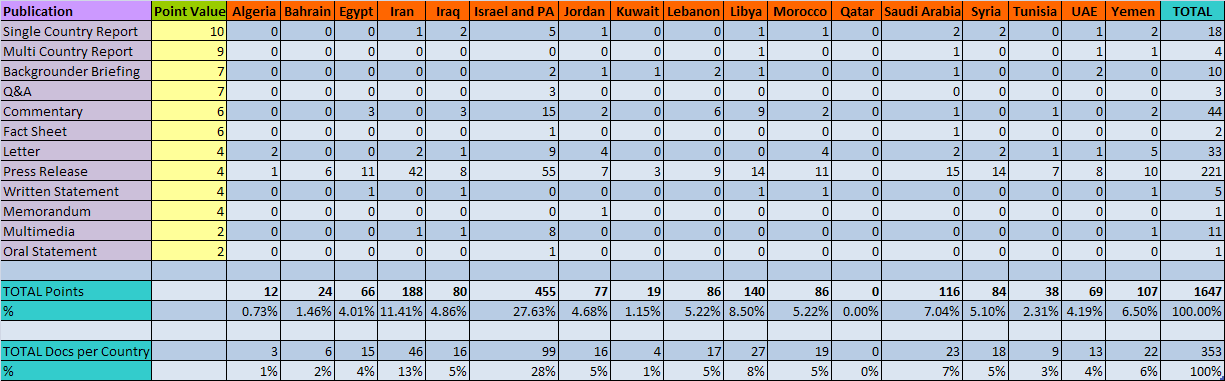
2008
Examining Human Rights Watch in 2008: Double Standards and Post-Colonial Ideology, January 13, 2009
Summary
- Quantitiative analysis of HRW’s publications in 2008 reflect the portrayal of Israel as the second worst abuser of human rights in the Middle East. Only Saudi Arabia received more attention, with chronic human rights abusers Iran, Syria, Jordan and Egypt receiving less.
- Analysis of HRW’s use of international legal and human rights terminology to condemn Middle Eastern states demonstrates unjustified emphasis that singles out Israel. HRW ignores Palestinian terrorists’ use of human shields.
- In 2008, Israel and the Palestinians were the only countries in the Middle East region suspected or accused of “war crimes” by HRW: Israel on six occasions, and the Palestinians in one instance for suicide bombings. HRW placed Israel on par with Sudan, leaders from the former Yugoslavia, Congo and Uganda.
- In 2008 HRW does not call for the release of, or Red Cross access to captured Israeli soldier Gilad Shalit.
- Israel was condemned for violations of “human rights law”, “humanitarian law”, or “international humanitarian law” (IHL) 33 times, compared with 13 citations for the Palestinians, 6 for Hezbollah and 5 for Egypt.
- The evidence suggests that HRW’s Middle East personnel approach the Israeli- Palestinian conflict from a post-colonialist ideological perspective, rendering Israel a special case in the Middle East. The double standards and political bias expressed by senior HRW officials in the Middle East Division reinforces this interpretation (see examples below). And the significantly different tone exhibited when reports on Israel involve other HRW departments, indicates that personal political agendas influence reporting. This is clear for Sarah Leah Whitson, Joe Stork, Marc Garlasco, Lucy Mair, and in the addition of Nadia Barhoum in 2008.
This report includes quantitative analyses of publications from HRW’s Middle East and North Africa section, using a weighted scale methodology consistent with NGO Monitor’s previous analyses, and an assessment of the use of language in HRW‘s publications.
Agenda Analysis: Israel second only to Saudi Arabia as worst human rights abuser in Middle East
In 2008, HRW’s Middle East coverage narrowed compared with recent years, with much fewer countries receiving significant attention[1], and exhibited a disproportionate interest in Saudi Arabia and Israel. Even before the Gaza conflict ignited on December 27, 2008,[2] (which provoked the publication of a press release and “Q&A” document before the end of the year), the focus of HRW’s publications portrayed Israel as the second worst abuser of human rights in the Middle East.
This study employs the quantitative method used by NGO Monitor beginning in 2004,[3] to count the number of HRW publications on each Middle Eastern country and weight the types of publications for resource consumption and relative impact. The only methodological change in 2008, was an adjustment in the weighting system, to reflect changes in HRW’s website and categorization. (See appendix for more details).
The analysis found that HRW focused most on Saudi Arabia (184 points), followed by Israel (131 points), then Iran (123), Jordan (101), Egypt (99) , the Palestinians (66)[4], Syria (58), Libya (55), Yemen (48), Morocco (45), Tunisia (31), Bahrain (27), Algeria (21), Kuwait (8) and UAE (8). Publications on Israel comprised 12% of the total, compared with 10% in 2007, 20% in 2006 (due to the Second Lebanon War) and 8% in 2005. This percentage fluctuation may not seem significant (other than the 2006 figure which can be considered an outlier), but the narrower range of countries covered in depth,[5] combined with a steady growth in the level of resources devoted to documenting allegations of Israeli human rights violations, resulted in Israel receiving more attention than Iran, Egypt, Libya, Syria, and other chronic human rights abusers in the region.
Chart: Proportion of HRW resources devoted to each Middle Eastern country in 2008

(Note that Iraq and Lebanon are included under the same criteria as previous years. See Appendix for details).
The graph below shows how HRW’s relative focus has changed since 2005. Focus on Syria and Jordan has risen steadily, while attention to Iran and Egypt is falling. Israel’s line reveals a steady increase, if the 2006 figure is excluded.

The level of attention on the Palestinians remained constant at 6% (the same as in 2007). But to HRW’s credit, it published a 113 page report on the Palestinian’s “Internal fight” in July 29, 2008, an important change since 2007.
Qualitative Analysis of Language in HRW Publications
A qualitative analysis of HRW’s use of international legal and human rights terminology to condemn Middle Eastern states, demonstrates a strong bias against Israel. (Terms were counted when they specifically condemned the country government – hence a separate category was designated for Hezbollah, to avoid confusion with the Lebanese government).
- In 2008, HRW used “war crimes” in relation to the Israeli-Palestinian conflict seven times. In six instances the accusation was directed at Israel, and once[6] it was used to describe “indiscriminate Palestinian rocket and suicide bomb attacks against Israeli civilians.” (In numerous other cases when suicide bombings are not mentioned, HRW notably fails to label rocket attacks as war crimes). No other Middle Eastern state was accused of “war crimes” in 2008. A search of HRW’s website for the use of this term in 2008 returned 213 results, concentrated on Sudan, leaders of the former Yugoslavia, Congo and Uganda.
- Israel was condemned for “violations of human rights law”, “humanitarian law”, or “international humanitarian law” (IHL) 33 times, compared with 13 citations for the Palestinians, 6 for Hezbollah and 5 for Egypt.
- HRW accused Israel of “illegal” or “unlawful” activity, or “violating the law” 26 times in 2008, compared to 17 citations for the Palestinians, 6 for Yemen, and less than 4 citations for other Middle Eastern countries.
- Accusations of “international law violations” were also primarily directed at Israel: 15 citations for Israel, 9 for Iran, and 6 for the Palestinians.

This table provides strong evidence that HRW singles out Israel for special attention, and applies unique standards compared with other countries in the Middle East. Israel is subject to particularly harsh and unjustified condemnation, using terms that delegitimize its policies and military operations. The peak in Palestinian numbers in the chart shows a limited attempt at “balance” in HRW coverage of the Israeli-Palestinian conflict, including limited acknowledgement of Palestinian human rights violations, reflecting an adjustment following previous NGO Monitor analyses.
Double Standards
In one of three items[7] covering the accidental death of a Reuters cameraman in Gaza, Joe Stork alleged that, “Israeli soldiers did not make sure they were aiming at a military target before firing, and there is evidence suggesting they actually targeted the journalists…” Stork continues, “Anyone who deliberately or recklessly attacks civilians commits a war crime.” In contrast, HRW condemns Palestinian rocket attacks as “unlawful” and “violations of international humanitarian law,” yet repeatedly avoids suggesting that they deliberately target civilians. In the majority of reports, these attacks are labeled “indiscriminate …because they are highly inaccurate and cannot be directed at a specific military target,”[8] and in only three instances does HRW label them “deliberate” (while only calling them “war crimes” in one instance, when grouped together with suicide bombings).[9]
HRW’s three press releases published within days of the cameraman incident and its choice of language demonstrate the disproportionate focus aimed at Israel. Only one month before this incident, HRW remained silent following the Mercaz Harav Seminary attack in Jerusalem on March 6, 2008, where a Palestinian opened fire in a school library, killing eight youths and wounding 11 others. This was a deliberate attack targeting children in violation of law under any standard. Sarah Leah Whitson’s only mention of the crime, however, was in passing in a document condemning Israel’s proposed response, to demolish the terrorist’s home. Whitson states, “The assault on Mercaz Harav seminary… [was] appalling, but Israel shouldn’t respond by trampling on basic rights…the house demolition measures would violate international law because they punish people who are not even accused, let alone convicted of a crime.”[10] (Israel did not destroy the house.)
Omission of Human Shields
In sharp contrast, HRW has been far slower in responding to internal Palestinian violence in which Israel is not involved. While repeatedly condemning Israel for its “failure to take all steps feasible to minimize civilian loss… in Gaza,” [11] HRW does not address the culpability of Hamas, Islamic Jihad, and others, who choose to launch rockets from heavily populated civilians areas. In 49 references to “civilians” in HRW documents related to Palestinians in 2008, every instance that ascribed blame called on Israel to protect Palestinian civilians, erasing Hamas’ role – its responsibility and negligence in protecting non combatants in clear violation of the rule of distinction under IHL. Joe Stork’s[12] comment summarizes this attitude:
“Israel has an obligation during military operations to minimize civilian deaths… The continuing high civilian casualty rates in Gaza suggest that this obligation is not being met.”
This omission of “human shields” from a human rights analysis of any asymmetric combat adds to the overall distortion, and to HRW’s highly misleading characterization of many aspects of the Gaza situation.
HRW’s distortions of International Law in relation to Gaza
In 2008,[13] HRW published 18 condemnations of Israel’s response to deliberate attacks launched from Gaza and aimed at civilians. These statements exploit international legal terminology, repeat incomplete or false analyses of international law, and minimize or omit Hamas’ attacks on Israeli border crossings where humanitarian aid is delivered, as well as the diversion of this aid by Hamas. Far from carefully written, accurate and well-sourced legal analyses, these publications reflect a dominant political agenda.
Claim: Israel’s restrictions on the flow of goods and services into Gaza “constitute [s] collective punishment against the civilian population, a serious violation of international humanitarian law.”
Analysis: HRW continues to apply the label of “collective punishment” selectively and incorrectly to Israel (see NGO Monitor’s analysis here). Restriction on the flow of goods in a war environment does not constitute “collective punishment” under international law. “Collective punishment” refers to the imposition of criminal penalties and not to the legal act of retorsion (e.g. sanctions, blockades). Pursuant to Article 23 of the Geneva Convention (which sets standards for the provision of limited humanitarian aid),[14] Israel has no obligation to provide any goods, even minimal humanitarian supplies, if it is “satisfied” that such goods will be diverted or supply of such goods will aid Hamas in its war effort. Israel is also bound by several international treaties restricting the financing and support of terrorism. Provision of goods that ultimately aid Hamas in its terror campaign would place Israel in breach of these legal obligations. As numerous credible accounts have reported, Hamas has diverted supplies from Gaza’s civilian population, but this is omitted from HRW reports.
Although Israel is under no legal obligation and despite the diversion as well as attacks on the Israeli border crossings, including the April 9 attack on the Nahal Oz fuel depot and the May 22 truck bomb attack at the Erez crossing, Israel continued to provide hundreds of tons of humanitarian supplies to Gaza on a weekly basis. This is above and beyond any obligation under international law, and the claim of “collective punishment” can best be explained as part of HRW’s post-colonial ideological filter.
Claim: HRW argues that the deliberate targeting of civilians by Hamas ” [does] not permit unlawful actions – in this case collective punishment – by the other.”
Analysis: This claim attempts to portray Israel’s lawful right to exercise self-defense against attacks on its civilians as a violation of international law. As shown above, Israel is not engaging in “collective punishment,” nor are Israel’s actions in any way “unlawful.” Indeed, under international law, the only legitimate uses of force are for purposes of self-defense or pursuant to Security Council authorization under Chapter VII of the UN Charter. Article 51 of the UN Charter, states: ” [n]othing in the present Charter shall impair the inherent right of individual or collective self-defense if an armed attack occurs against a Member of the United Nations, until the Security Council has taken measures necessary to maintain international peace and security.” Israel, therefore, has the unequivocal right to engage in self-defense to prevent attacks against its civilian population.
Claim: Israel maintains “continued effective occupation of the Gaza Strip.”
Analysis: Gaza cannot be considered “occupied” under any reasonable interpretation of international law. HRW claims that Gaza is occupied because Israel “still maintains effective control over the territory via its control of Gaza’s land borders, airspace, [and] territorial waters”. This argument is false both as a matter of fact and a matter of law, and largely parrots a “legal” opinion circulated by the PLO prior to Israel’s disengagement in August 2005. Under both the Hague and Geneva Conventions, as well as judicial interpretation of these provisions,[15] the standard of “effective control” refers solely to the exercise by a hostile army of governmental authority – not control of borders. Thus, in no way can Israel be said to exercise governmental authority in Gaza. Indeed, as Egypt controls the southern border of Gaza, and based upon its occupation of Gaza from 1948-67, under HRW’s reasoning, Egypt would also be considered to be occupying Gaza. Instead, these claims also reflect the impact of ideology in HRW publications.
Claim: Gaza continues to be occupied because Israel “maintains effective control over… tax collection, and population registry.”
Analysis: The statement that Israel controls tax collection and the population registry in Gaza is also clearly false and HRW provides no source to support this allegation. Beginning in 1994, the Palestinian Authority became responsible for the establishment and collection of all taxes within Gaza, and this is now controlled by Hamas following its June 2007 coup. Israel has no power to set or collect such taxes. Pursuant to international agreement, Israel collects custom duties for cross-border transactions on behalf of the PA, but only a highly distorted interpretation would conclude that Israel is “controlling” tax collection in Gaza. Moreover, Israel has no control over what population registry the PA and Hamas choose to use (the fact that the PA and Hamas continued to use of the population registry system established by Israel following 1967 is not Israel’s decision.) [NGO Monitor contacted HRW a number of times requesting information on the source of these claims, but received no response].
Claim: Gaza continues to be “occupied” because “Israeli military forces can and regularly do re-enter Gaza at will.”
Analysis: Again, territory is considered “occupied” under international law solely if the hostile army exercises the functions of “governmental authority.” The test is not whether an army has the potential to enter a territory to conduct military operations.
HRW’s Middle East Division Driven By Post-Colonial Ideology
When HRW was awarded the United Nations Prize for Human Rights in November 2008, Kenneth Roth commented “By raising the cost of abuse, we make governments think twice about violating the rights of their people.” But the inconsistencies in HRW’s agenda and the excessive focus on Israel, suggest an alternative hypothesis: that HRW’s approach to the Israeli-Palestinian conflict is rooted in a post-colonialist paradigm, which defines Palestinians as victims, and views Israel as a perennial aggressor. The double standards and political bias expressed by senior HRW officials in the Middle East Division reinforces this interpretation (see examples above). And the significantly different tone exhibited when reports on Israel involve HRW members from outside the Middle East Division, indicates that personal political agendas influence reporting. This is clear in the case of Sarah Leah Whitson, Joe Stork, Marc Garlasco and Lucy Mair, whose virulent anti-Israel approach is apparent in their publications.[16]
The addition of Nadia Barhoum, a pro-Palestinian campus activist, to HRW’s Middle East and North Africa Division, also reflects and reinforces these agendas. Barhoum was an active member in Students for Justice in Palestine (SJP) at the University of California, Berkeley. SJP promotes the Durban agenda of demonization of Israel, using terms such as “apartheid,” as well as accusations of “mass atrocities.” In promoting divestment, Barhoum wrote: “Our university should not profit from bloodshed. Our university should not invest in apartheid.”[17]
In contrast, when HRW researchers from other departments are involved in reports, Israel is not singled out for vilification. This can be seen in the November 2008 “Sinai Perils” report, which was authored by “Bill Van Esveld, Arthur Helton fellow” [a sponsorship scheme for young lawyers to pursue a career in protecting refugee rights]” and edited by Bill Frelick, director of the Refugee Program and Policy Program, in addition to Stork. This report condemns Israel for an inconsistent policy that includes returning migrants to Egypt and “arbitrary” and “prolonged” detentions, yet it does not employ demonizing rhetoric or double standards in its analysis. Moreover, the report devotes significant attention to grave abuses by Egyptian soldiers and government officials such as the shooting of migrants attempting to cross into Israel, arrests, disappearances, denial of asylum, and the denial of medical care to migrant-prisoners. This is a marked difference to HRW’s coverage of Gaza originating in the Middle East department where Egypt’s role is rarely, if ever, mentioned.
“Sinai Perils” stands in stark contrast as well to the March 2008 “Off the Map” report, written by Lucy Mair (who has a history of anti-Israel activism but has now left HRW) and edited by Joe Stork.[18] NGO Monitor’s detailed analysis of the 130 page “Off the Map” report, examines the deceptive use of human rights terminology, simplification of the complex challenge of integrating the Bedouin community, and omission or distortion of factors that do not support HRW’s political message, including any mention of Egypt or Jordan.
Marc Garlasco’s joint authorship of the February, 2008 Report, “Flooding South Lebanon” is also suspect, given his dubious qualifications and record of anti-Israel reporting at HRW. (It was Garlasco who led HRW’s high profile “investigation” into the Gaza Beach incident in 2006, and repeated the claims that “the evidence overwhelmingly supports the allegations that the civilians were killed by artillery shells fired by the IDF” accepting the Palestinian position. He ignored detailed evidence to the contrary, including shrapnel removed from the victims taken to Israel for treatment. Garlasco was also among the authors of HRW’s “Razing Rafah” report of 2004, which contained many unverifiable and disputed claims, erased the context of terror, and was used to justify HRW involvement in anti-Israel boycott campaigns.) Garlasco’s 2008 report alleges that “the IDF’s use of cluster munitions was both indiscriminate and disproportionate, in violation of IHL, and in some locations possibly a war crime.”
Conclusion:
HRW’s Middle East coverage continues to reflect deep biases in its agenda and reporting. The disproportionate focus on Israel in 2008 resulted in the shift of resources and attention from far more serious human rights violations in other countries. Despite some valuable attention on intra-Palestinian fighting, HRW’s still blames Israel alone for civilians deaths in Gaza, erasing the context and ignoring the extensive use of human shields by Hamas. HRW officials also distort international legal terminology and repeat false or incomplete analyses of international law in order to promote their political view of the conflict in Gaza. These phenomena can be attributed to the radical political ideologies of senior members of the Middle East Division, a systemic problem which must be addressed if HRW is to salvage any legitimacy in its coverage of the Middle East.
Notes
[1] In 2007 HRW wrote at least one country report on 13 countries. In 2008, only 8 countries were covered in this depth. (Saudia Arabia was the subject of 5 country reports).
[2] The quantitative part of this report covers the period from January 1, 2008 to December 22, 2008. It does not include HRW’s coverage of the Gaza conflict.
[3] To review NGO Monitor’s quantitative analyses of HRW’s Middle East coverage since 2004, see
Human Rights Watch: A Comparative Analysis of Activities in the Middle East, 2002-2004
Human Rights Watch in 2005: Political Bias Against Israel Continues Despite Wider Middle East Focus
Report on HRW’s Activities in 2006: Political Bias Undermines Human Rights
NGO Monitor’s 2007 Report on HRW: Bias and Double Standards Continue)
[4] Note: The “Palestinians” includes references to Hamas, Fatah, the Palestinian Authority, “Palestinian militants,” “armed groups,” “security forces” and individually named terrorist groups: “al Quds,” “Islamic Jihad” etc.
[5] See footnote 1
[6] See “Gaza: Israel’s Energy Cuts Violate Law of War,” February 6, 2008
[7] The 3 items are “Israel: Investigate Death of Gaza Civilians,” April 18, 2008; “Israel: Independent Probe Needed In Gaza Killings,” May 1, 2008 and ” Letter to IDF JAG on investigation into Death of Four Civilians,” April 30, 2008.
[8] “Letter to Hamas to Stop Rocket Attacks,” HRW, November 20, 2008. Other similar characterizations of rocket attacks are made throughout HRW’s statements on Gaza in 2008.
[9] The 3 citations are in “Written Statement on Gaza to the UN Human Rights Council”, January 21, 2008; “Gaza Strip, Civilians bear brunt of attacks,” February 28 ,2008; “Letter to Hamas to Stop Rocket Attacks,” November 20, 2008. The singular instance of rocket attacks being termed “war crimes” in 2008 is in “Gaza: Israel’s Energy Cuts Violate Law of War,” February 6, 2008: ” Human Rights Watch said that indiscriminate Palestinian rocket and suicide bomb attacks against Israeli civilians constitute war crimes, but Israel’s attempts to suppress those attacks must not also violate international humanitarian law.”
[10] “Israel: Don’t destroy Homes,” HRW August 9, 2008
[11] ” Letter to Hamas to Stop Rocket Attacks,” November 20, 2008
[12] “Gaza Strip, Civilians bear brunt of attacks,” February 28, 2008
[13] Note this study covers January 1 – December 22, 2008
[14] Article 23 provides that:
Each High Contracting Party shall allow the free passage of all consignments of medical and hospital stores and objects necessary for religious worship intended only for civilians of another High Contracting Party, even if the latter is its adversary. It shall likewise permit the free passage of all consignments of essential foodstuffs, clothing and tonics intended for children under fifteen, expectant mothers and maternity cases.
The obligation of a High Contracting Party to allow the free passage of the consignments indicated in the preceding paragraph is subject to the condition that this Party is satisfied that there are no serious reasons for fearing:
(a) that the consignments may be diverted from their destination,
(b) that the control may not be effective, or
(c) that a definite advantage may accrue to the military efforts or economy of the enemy through the substitution of the above-mentioned consignments for goods which would otherwise be provided or produced by the enemy or through the release of such material, services or facilities as would otherwise be required for the production of such goods.
The Power which allows the passage of the consignments indicated in the first paragraph of this Article may ma permission conditional on the distribution to the persons benefited thereby being made under the local supervision of the Protecting Powers.
Such consignments shall be forwarded as rapidly as possible, and the Power which permits their free passage shall have the right to prescribe the technical arrangements under which such passage is allowed.
It is argued that Article 23 does not apply to the case of Gaza. If that is so, then Israel is under no legal duty to provide even the minimal humanitarian supplies listed in Article 23.
[15] See, e.g., The Hostages Trial, Trial of Wilhem List, United Nations War Crimes Commission, Law Reports of Trials of War Criminals, Volume VIII, 1949, at 55-6, available here (holding that “an occupation indicates the exercise of governmental authority to the exclusion of the established government… To the extent that the occupant’s control is maintained and that of the civil government eliminated, the area will be said to be occupied”.)
[16] In one media report, when Joe Stork was challenged with NGO Monitor’s analysis of the evidence of an anti-Israel ideology in his reports, Stork replied angrily and without any substance. (See http://www.jpost.com/servlet/Satellite?cid=1209626989868&pagename=JPost%2FJPArticle%2FPrinter )
[17] See also “HRW Hires Another pro-Palestinian Activist,” October 29, 2008 (includes background information on prominent HRW officials)
[18] In this analysis I am excluding mention of the Program directors that seem to be involved in editing all HRW reports. I assume that their role is one of final quality control and that they do not have the time or the necessary knowledge to query the core research and portrayal in the report.
2007
NGO Monitor’s 2007 Report on HRW: Bias and Double Standards Continue, April 29, 2008
“The point is not to equate, excuse or balance abuses but to demonstrate that reporting is based on human rights principles rather than partisan considerations.” HRW’s Position Paper on the Durban Preparatory Committee (April 21, 2008):
The following analysis demonstrates that HRW’s own activities related to Israel continue to fall short of this basic standard of universality
Summary:
- Analysis of Human Rights Watch‘s use of the rhetoric of international law and other terminology shows continued double standards and misleading or false claims.
- HRW accuses Israel of “collective punishment” of Palestinians in a way that is inconsistent with both international law and past and present usage of the term by HRW itself.
- HRW’s focus on Israel in 2007 dropped to 2005 levels after 2006 marked a return to the extreme bias of the 2000-2004 period. The change in 2007 allowed more resources to be focused on countries committing major human rights violations.
- However, disproportionate emphasis on Israel continued, with major reports covering 400 pages in 2007, using the same methodologies as in 2006 that lack credibility.
- This contrasts with the limited attention on human rights violations in Libya, Syria, and other countries in the region.
- Israel was the focus of more multimedia items (audio, video, graphics) than any other country in the region.
- Reports on Israel continue to be based on unverifiable evidence provided by “eyewitnesses,” selected journalists, and other inappropriate sources. In some cases hard evidence has shown this testimony to be blatantly untrue.
- HRW mentioned one or more of the kidnapped Israeli soldiers in a total of only 6 publications. Of these, only two refer to them by name; the other references are in passing.
This report includes quantitative analyses of publications from HRW’s Middle East and North Africa section, using a weighted scale methodology consistent with NGO Monitor’s previous analyses, and an assessment of the use of language in the HRW publications.
Agenda Analysis: Focus on Israel returns to 2005 levels
NGO Monitor’s analysis of Human Rights Watch’s (HRW) output devoted to each country in the Middle East and North Africa region shows that the focus on and condemnations of Israel in 2007 returned to 2005 levels (see 2005 report). This follows a sharp increase in 2006 (see 2006 report). However, Israel is still the focus of nine percent of HRW’s output on the region– significantly greater than Libya, Syria, Hamas, Hezbollah and other chronic human rights violators. The evaluation is based on a point system which accounts for both the volume of publications and their significance (a report clearly being much more significant and requiring more resources than a press release –see the methodological section of the appendix).
Figure 1 provides a comparison of the relative output (weighted as described in the methodology section in appendix) of countries in the Middle East over the past three years. Figure 1 demonstrates the degree that an increased focus on Israel correlates with a decreased focus on other countries in the region, such as Iran and Egypt.1 In absolute terms, HRW’s total output on the Middle East and North Africa has increased steadily over the period 2005-2007, the results presented here are in percentage terms to enable comparison.
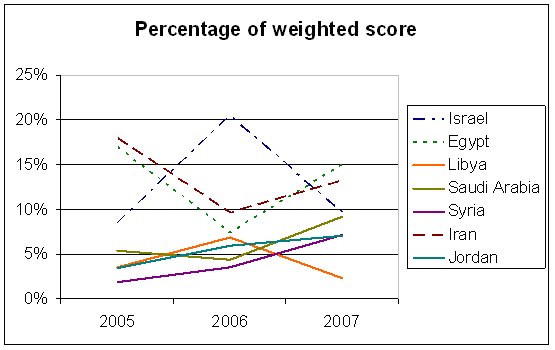
Figure 1 Percentage of weighted sore 2005-2007
Figure 2 displays the results of the detailed comparative analysis of the activities of HRW’s Middle East and North Africa section in 2007. In 2007, 10 percent (121 points) of HRW publication effort in the Middle East and North Africa section focused on Israel, which is significantly lower than in 2006, and slightly higher in percentage terms than the 8 percent in 2005.2
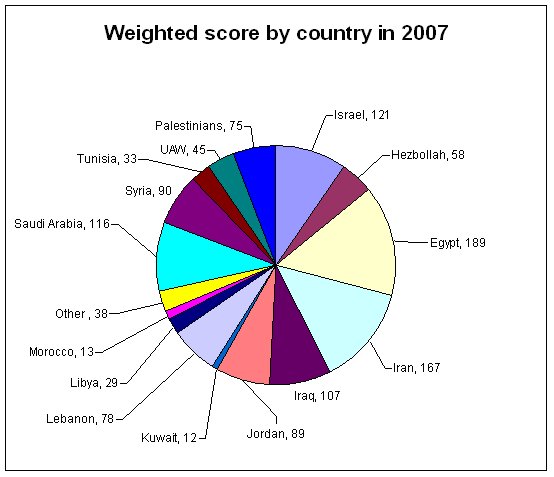
Figure 2 Figure 2 Weighted score by country in 2007 in the Middle East / North Africa region. [Note that Iraq and Lebanon are included under the same criteria as pervious years- see appendix for further explanation]
Use of Multimedia items
In 2007 there were more multimedia items on Israel (6 audio, video and graphics items) than any other country (4 for Hamas, 4 for Iran and 3 for Egypt – other countries received 2 or fewer). Most countries, including Israel, featured in one audio item each as part of the 2007 World Report. Israel’s multimedia items also included audio commentary by Marc Garlasco on cluster munitions, pictures and audio on medical evacuations3, pictures and audio on students trapped in Gaza, and a video on cluster munitions. Multi-media material requires a higher level of investment by Human Rights Watch and can in many cases result in a larger impact than is the case in other types of HRW activities. When this increased impact is disproportionately focused on Israel, the issue of double standards becomes relevant.
Use of Reports
HRW puts a great deal of effort and resources into its major reports, often including a press conference and other public relations activities to accompany the publication. In many cases, the focus of a report is chosen weeks or months in advance of publication, and reflects a strategic decision regarding HRW’s priorities.
The disproportionate emphasis on Israel continued in 2007. The number of reports featuring Israel in 2007 (2)4 was equal to the number on Hezbollah, Egypt, and Iraq. Only Lebanon featured in more reports (3).5 Significantly, HRW officials chose not to issue any reports on Iran, Libya and Morocco in 2007. (In contrast, HRW’s press releases focusing on human rights violations in Iran constituted 17 percent of total press releases in the region, with Egypt targeted in a further 17 percent. Israel received 9% of the press releases, a proportionate amount given it received 10% of the over all focus).
Priorities within the Arab Israeli conflict
HRW’s priorities are also reflected in an analysis of the relative coverage of Israel vis-à-vis the Palestinian Authority, Hamas, and Hezbollah. The analysis shows minimal attention to internal Palestinian fighting and an over emphasis on Israeli actions in both the conflict with Hezbollah and the Israeli-Palestinian conflict. Figure 3 demonstrates almost the same distribution between publications focusing on Israel and the total focused on all groups in conflict with Israel (i.e. Palestinian groups and Hezbollah). This was despite the fact that nearly half of all Palestinian fatalities were caused by intra-Palestinian violence during 2007. 6
When Hamas seized control of Gaza by violent coup in June 2007, there were many clear violations of human rights.7 Human Rights Watch itself documented a few briefly. One example was the execution by Hamas of a cook for Mahmoud Abbas’s Presidential Guard (press release “Gaza: Armed Palestinian Groups Commit Grave Crimes” – June 13). The cook was executed by “throwing him to his death, with his hands and legs tied, from a 15-story apartment building in Gaza City”. Over the year, only 2 published items from HRW focused primarily on internal Palestinian violence, a third published item covered both internal Palestinian violence and attacks on Israelis. This is in comparison with seven documents focused on Palestinian attacks on Israelis.
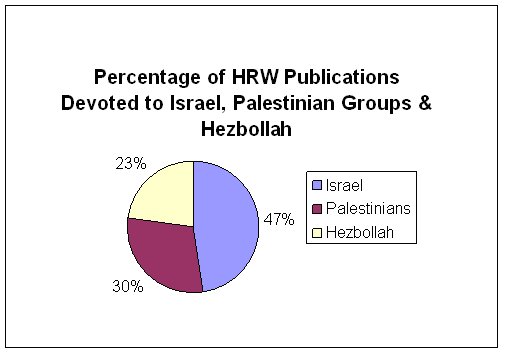
Figure 3 Israel, Palestinians and Hezbollah
Further comparisons between Israel and those in conflict with her are available in the appendix, including a breakdown of the collective term Palestinians.8
As noted, major reports require far greater resources, and are designed to have a greater impact, including the use of press conferences and public relations campaigns. In 2007, HRW published two reports which ostensibly analysed alleged human rights violations by Israel and by its opponent (Palestinian terrorists or Hezbollah). However, in “Why They Died: Civilian Casualties in Lebanon during the 2006 War,” 122 pages describe alleged Israeli abuses while 23 pages describe alleged abuses by Hezbollah. In “Indiscriminate Fire: Palestinian Rocket Attacks on Israel and Israeli Artillery Shelling in the Gaza Strip,” 72 pages describe alleged Israeli abuses, while 19 pages describe alleged Palestinian abuses. (The page counts exclude pages on general background information, methodologies and non substantive appendices)
Language Analysis – Double Standards Continue
As explained in previous NGO Monitor reports, the language and terminology used by NGOs in their publications on human rights issues is an additional indicator of the group’s relative emphasis and agenda. Terms such as “war crimes”, “collective punishment”, “torture”, “violations of international law”, etc. are condemnatory, and their inconsistent or unjustified use is at odds with the core universality of human rights norms.
This analysis (results in Figure 4) was conducted using the same methodology as in NGO Monitor’s 2006 report.9 In 2006, Israel, Libya, Iraq and UAE all averaged around thirty occurrences for various terms or phrases. The analysis of HRW’s rhetoric and vocabulary in 2007, compared to previous years, shows that the use of condemnatory language has been reduced across the board in the Middle East and North Africa region. The words provided in the key in Figure 4 (and very close approximations) were counted when they referred directly to the country indicated, (explanations, including the many cases where occurrences were discounted, are provided in the appendix).
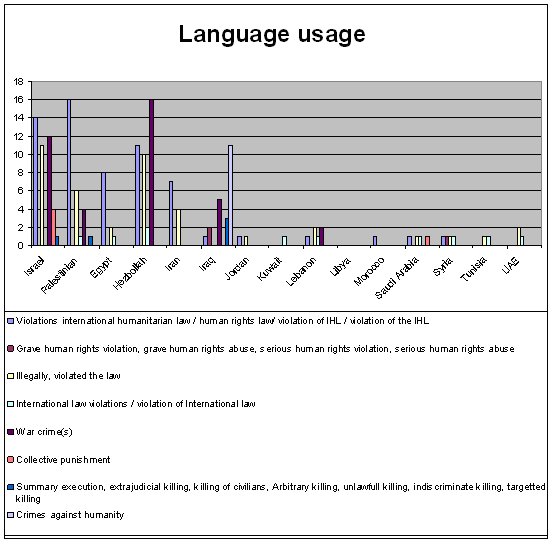
Figure 4: Language usage10
Misleading “balance” in HRW reporting
The relative increase and apparent “balance” in condemnation of Israel and its opponents is an improvement in reporting on the conflict, but still falls short of a even handed approach. This is because HRW’s reporting continues to distort the context and suggests a false moral equivalence between aggressor and defender. This is illustrated in an article by HRW’s Middle East and North Africa division director, Sarah Leah Whitson, published in Al-Akhbar on September 1, 2007. Whitson states:
“That Israel violated the laws of war does not justify the Islamic Resistance’s failure to abide by such laws. … that Israel carried out indiscriminate strikes on populated areas in southern Lebanon in no way justifies the Islamic Resistance’s retaliatory strikes on civilian areas in Israel.”
Although statistically such references count once against each party and are thus “balanced”, the context is clearly portraying Israel as the aggressor.
Similarly, a HRW press release (July 12, 2007) headlined “Israel/Lebanon: A Year Later, No Justice for War Violations,” states:
“During the conflict, Human Rights Watch documented serious violations of humanitarian law by both the IDF and Hezbollah… the Israeli army… thus systematically failed to distinguish between civilians and combatants, in violation of humanitarian law… [commanders] may be guilty of war crimes.”
After three paragraphs on Israel, the authors of the report turn to Hezbollah, providing some facts without the emotional comment. This section ends by stating,
“while Hezbollah appeared to target some of its rockets at military objectives…such attacks were at best indiscriminate attacks on civilian areas, at worst direct attacks against civilians…[Commanders] may also have committed war crimes and should be investigated.” (Emphasis added by NGO Monitor).
In the case of Israel the phrasing conveys culpability; in the case of Hezbollah, it only suggests a need to investigate.
Similarly, this text uses the phrase “violation of humanitarian law” to refer to Israel’s alleged failure to distinguish between civilians and combatants. In the case of Hezbollah, the same is suggested to be a “best case” analysis, with the worse case being the targeting of civilians. While Hezbollah’s actions are clearly a “serious violation” of international law, HRW officials refer to this as a hypothetical “worst case”. The use of such language shows a political bias against Israel in style and commentary.
This politically based distinction is repeated in HRW’s 249 page report that returns to the question of Israeli actions in the 2006 war with Hezbollah, headlined “Why They Died: Civilian Casualties in Lebanon during the 2006 War”, (September 2007). The authors describe events and simultaneously claim numerous violations of international law by Israel, eg “Israel often attacked targets that, under the laws of war, could not be considered military objectives subject to attack.”
HRW lacks both the expertise and the intelligence information to make this judgement, and it places the burden of proof on Israel, demanding additional information not known to HRW. In contrast, the section on Hezbollah’s use of human shields uses the language of uncertainty: “…we found a handful of instances but nothing to suggest a widespread practice” (page 6).
Such bias and double standards is also evident in a press release “Israel: Threatened Sanctions on Gaza Violate Laws of War” (September 20, 2007) written by Sarah Leah Whitson. According to Whitson, “Palestinian armed groups are clearly violating the laws of war by firing rockets deliberately or indiscriminately at Israeli civilians… Israel has the responsibility to protect its citizens, but not by collectively punishing the people of Gaza, which seriously violates the laws of war.” The term “collective punishment” (which is not applicable to this situation under international law – see detailed discussion below) is used to condemn Israeli responses to aggression, but not with respect to the deadly rocket barrages from Gaza. And as in many other instances, Whitson avoids holding Hamas responsible by name.
Whitson’s press release goes on to argue that “Israel remains an occupying power in the Gaza Strip… because it continues to exercise effective day-to-day control over most aspects of life in Gaza.” The dimensions listed are airspace, sea space and borders. In contrast, the accepted definition under international law of “day-to-day control over most aspects of life” as a condition of occupation, refers to the running of local government and facilities.11 Whitson also ignores Egypt’s role in Gaza.
Promoting the false claim of “continuing occupation”
Building on the false claim of “continuing occupation”, HRW holds Israel to a unique standard. Listing the obligations of “an occupying power” (i.e. supply of food and medical supplies to the civilian population), HRW then extends these obligations to “power and fuel” without legal basis. The reduction of fuel supplies between countries is not unique to Israel (e.g. Russia / Ukraine in 2006),12 and is not prohibited under current international conventions.13 HRW did not condemn Russia for this action nor refer to its control over fuel as creating a situation of “occupation”.
Areas of improvement
Finally, from multi-region documents examined in this analysis, there is evidence that these problems notwithstanding, HRW has heeded some of NGO Monitor’s previous analysis on language use. In one document “More Business Than Usual: The Work Which Awaits the Human Rights Council” (12 March) HRW officials outline their suggested agenda and priorities for the UN Human Rights Council. The document refers to “serious human rights abuses throughout Afghanistan”, “serious abuses, including extrajudicial killings, torture, beatings, arbitrary arrests, and rapes” in Chad, “serious human rights abuses, particularly those abuses committed by security forces” in Guinea, “militias were responsible for serious abuses of civilians, including killings, torture, and rape and sexual assault” in Sudan, and says the “police and army continue to commit serious and persistent human rights abuses” in Zimbabwe. Israel, Egypt, Iran, Iraq, and Saudi Arabia are also included in this report, yet with far more caution in the use of language.
HRW and the Kidnapped Israeli Soldiers
Two Israeli soldiers, Eldad Regev and Ehud Goldwasser, were kidnapped in July 2006 during a cross border raid by Hezbollah, in which 8 other Israelis were killed. Gilad Shalit was kidnapped from an Israeli position near Gaza in June 2006. All three remain in captivity and Hezbollah and Hamas have refused to allow visitation by the Red Cross.
In 2007, HRW mentioned one or more of the soldiers in a total of only 6 publications (There were 29 documents on Israel, 18 on the Palestinians and 12 on Hezbollah, many of which could have made reference to the soldiers). Of these, only two refer to them by name; the other references are in passing. In one report, HRW “criticized Hezbollah” for “illegally refusing” to confirm the condition of the soldiers and for not allowing the Red Cross access to them (“Why they died”, September 2007).
Charges of “Collective punishment”
In 2007, Human Rights Watch began using the phrase “collective punishment” to refer to Israeli self-defensive measures against rocket fire emanating from Gaza. This sweeping interpretation of the term is not consistent with international law,14 nor with the historic or current usage of the term by Human Rights Watch in other conflicts.
Using a Google search on HRW’s site as a heuristic, 55 percent of HRW’s content referring to blockades and collective punishment is related to Israel.15 (Note that this is 55% of all HRW material and not limited to the Middle East and North Africa section). However, Israel is the only case where HRW uses “collective punishment” to refer to a blockade and the potential impact on civilian life. In other cases, this term is used to describe beatings, murder and destruction of property as indiscriminant retaliation against a group of people for the acts of members of that group.
Other cases of blockades that are not termed “collective punishment,” include Azerbaijan’s blockade of Nagorno Karabakh and Armenia described in Human Rights Watch 1994 World Report:
“Electricity, gas, oil and grain-necessary for the basic human needs of civilians in Armenia-were in extremely short supply… … The lack of gas and electricity deprived Armenians of heat in the freezing winter… a rise in deaths among the newborn and the elderly was accompanied by a higher suicide rate and growing incidence of mental illness. The blockade had ruined Armenia’s industry…”
The report does not refer to this “blockade” as “collective punishment,”, and indeed recommends that “all but humanitarian aid should be withheld from Armenia because of Armenia’s financing of the war”. It is not clear why HRW promotes a policy of economic isolation for Armenia, but when Israel must respond to daily rocket attacks on civilian population centers, HRW condemns a similar policy as “collective punishment.”
Similarly, in a 1999 press release on Chechnya, “Russian Ultimatum to Grozny Condemned” (8 Dec, 1999) HRW described the humanitarian situation as
“rapidly deteriorating, with no functioning hospitals, electricity, running water, gas, or heating since the beginning of November, and dwindling food supplies”.
This is clearly a more urgent humanitarian situation than Gaza in 2007 (where humanitarian aid enters daily16), but HRW did not classify it as “collective punishment.”
In 2007, the term “collective punishment” was used by HRW in 13 items not referring to Israel (see Table 1). These cases generally provide evidence of punitive intent against third parties either at the family or community level.
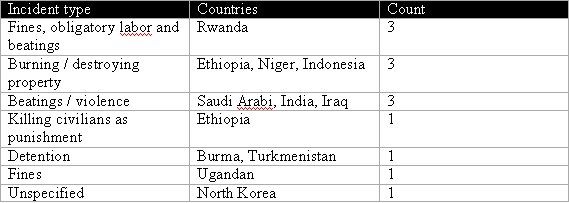
Table 1 Collective punishment in 2007 HRW publications
The items in Table 1 show HRW’s use of “collective punishment” in highlighting reprisal actions against third parties. For example, in 2007, testimony to a US House Committee on Foreign Affairs, Subcommittee on Africa and Global Health, Sam Zarifi (HRW’s “Washington Advocate”)17 stated,
“in the Ogaden, we have documented massive crimes by the Ethiopian army, including… villages burned to the ground as part of a campaign of collective punishment”.
Another example is found in an August 2007 Guardian article, “Ethiopia’s dirty war” authored by HRW’s London Director, Tom Porteous18. He asserts that
“dozens of civilians have been killed in what appears to be a deliberate effort to mete out collective punishment against a civilian population suspected of sympathising with the rebels.”
These results show that HRW’s application of “collective punishment” is inconsistent and arbitrary. No other “blockade” is described in these terms, and other cases of “collective punishment” involve beatings, murder and destruction of property as indiscriminant retaliation against a group of people for the acts of members of that group.
Use of eye witnesses and unverifiable evidence
In many reports on Israel, Human Rights Watch relies extensively on unverifiable evidence, including accounts from “eyewitnesses” and selected journalists.
In the 145 page (English) report “Indiscriminate Fire”19 Human Rights Watch returns to the disputed Gaza beach incident from 2006.20 This account presents interviews with family members of the victims who claim Israeli shelling was responsible for the causalities. Their stories, however, were contradicted by evidence available to HRW prior to the publication of this report. This evidence includes IDF records of all artillery fired prior to the explosion, the fact that no missiles were actually fired within 10 minutes of the explosion, and forensic evidence of shrapnel removed from victims which was not consistent with an Israeli shell21. When presented with the evidence by the IDF at the time, Human Rights Watch noted (Jerusalem Post, June 19, 2006) that the IDF investigation made “a good assessment” in ruling out an IDF shell as the cause of the blast.22 The use of emotionally involved witnesses, in this case a year after their testimony is invalidated by evidence, is a systematic fault in HRWs research methodology. Their approach favours narrative over verifiable evidence-based research.23
Another section of the “Indiscriminate Fire” report discusses an exchange of fire in the vicinity of the Nada Apartments Complex, situated on the western edge of Bet Hanoun in Gaza. A footnote states that, “the testimony of one resident that a rocket may have been fired from the roof of one of the buildings on the evening of July 24 was not supported by Human Rights Watch’s on-site investigation”. This investigation was a physical inspection which found “no burn marks or other indications that a rocket had been fired from there”. Such a lack of evidence cannot prove anything — it only fails to support the eyewitness claim. The report goes on to say that “Many Nada residents freely acknowledged Palestinians firing rockets from the nearby open areas, sometimes close to the apartments, but all except for this person insisted that no rockets had ever been fired from the grounds of the complex or the roofs of the buildings.” In this case, HRW tries to bolster the credibility of eye-witnesses, who have every reason to lie (they surely know that rocket-fire from their homes would render them legitimate targets for IDF reprisal). In order to support their conclusions, HRW does its own investigation which finds nothing, and rejects the evidence of one eyewitness whose counter-evidence is the only non-interested testimony HRW has.
In a third example, HRW’s report “Why they died”24 acknowledges the errors resulting from reliance on eyewitnesses. It states, “In our earlier report, Fatal Strikes, Human Rights Watch did not have information about Hezbollah firing from the area.” The authors further note that the eyewitness stated “To my knowledge, Hezbollah was not operating in the area, but I can’t be 100 percent sure because we were sleeping.’” This quote omits the first sentence of the original quote from Fatal Strikes which stated, “I am positive the family had nothing to do with Hezbollah” (pg 25).
Nevertheless, “Why they died” also uses eyewitness accounts to assert that “the handful of cases of probable shielding that we did find does not begin to account for the civilian death toll in Lebanon.” The cases HRW found may well be a fraction of the total cases. In an area still largely controlled by Hezbollah, there is a strong incentive against whistle blowing on the use of Human shields, and many uses of civilian space will leave no physical evidence. A lack of evidence cannot be used to make categorical and empirical claims.
Conclusions
Although HRW’s relative focus on Israel in 2007 is less than in 2006, the disproportionate emphasis, and the examples of bias and double standards continue. Despite a major increase in internal Palestinian violence during 2007, including the Hamas takeover of Gaza, HRW’s focus on Israel has not changed significantly. Similarly, in the selective use of language, especially the arbitrary accusation of “collective punishment,” HRW’s strong political agenda with respect to Israel is clear.
See the appendix to this report
Footnotes
1 Lebanon and Iraq have been excluded from this longitudinal analysis due to the impact and separate reporting on external actors in these countries. These factors make data analysis on these countries between years inconsistent. This does not impact on the accuracy of reporting within a given year.
2 121 of 1260 points were devoted to Israel in 2007, compared to 59 of 702 points in 2005. In 2006 223 of 1088 points (over 20%) were focused on Israel, this is partly explained by the Second Lebanon War. The total publications (in terms of both weighted score and in terms of actual number of documents) has steadily increased across the region over the last three year. The percentage of these documents dedicated to Israel has been erratic over the three year period.
3 The pictures and audio alleging that Israel prevented residents of Gaza from leaving to seek external medical treatment are also linked at the top to a press release. This has been included as a multimedia item in this report.
4 “Indiscriminate Fire” and “Why they Died.”
5 One on the Lebanon War (Why they died), one on Iraqi refugees (Rot here or die there) and one on domestic workers (Exported and Exposed)
6 According to the data published by B’tselem, 351 Palestinians were killed by other Palestinians (http://www.btselem.org/english/Statistics/Casualties_Data.asp?Category=23) compared with 379 casualties from clashes with Israeli security forces (http://www.btselem.org/english/Statistics/Casualties_Data.asp?Category=1). Such data is not reliable, and if anything, underestimates the extent of internal Palestinian violence.)
7 Examples include “Hospitals offer no safety in Gaza strip,” ABC News, 13 June, 2007 and “Crowd loots Gaza home of Arafat,” Ali Waked and Reuters, 16 June, 2007.
8 To avoid double counting, publications with attention given to at least one of: the Palestinian Authority / Fatah, Hamas or “Palestinian armed groups” were included in the Palestinian count.
9 In the language analyses of previous years, NGO Monitor included “torture”. In 2007, HRW did not use the term torture in any reports on Israel, while Palestinian torture related to factional violence received a single mention. This data is presented in a separate graph in the appendix.
10 See methodology section for more details
11 “Is Israel Bound by International Law to Supply Utilities, Goods, and Services to Gaza?” Abraham Bell, JCPA Vol. 7, No. 33 28 February 2008
12 Peter Finn, Russia Cuts Off Gas to Ukraine In Controversy Over Pricing, Washington Post, Monday, January 2, 2006, Page A07
13 “Is Israel Bound by International Law to Supply Utilities, Goods, and Services to Gaza?” Abraham Bell, JCPA Vol. 7, No. 33 28 February 2008
14 See “International Law and Gaza: The Assault on Israel’s Right to Self-Defense,” Jerusalem Viewpoints (Jerusalem Center for Public Affairs) Vol. 7, No. 29, Abraham Bell, January 28, 2008; and Dr. Avi Bell, “Is Israel Bound by International Law to Supply Utilities, Goods, and Services to Gaza?” Jerusalem Viewpoints (Jerusalem Center for Public Affairs) Vol. 7, No. 33, 28 February 2008,
15 When searching site:hrw.org blockade and “collective punishment” +Israel 77 results are returned. When searching site:hrw.org blockade and “collective punishment” -Israel 63 results are returned. The 77 documents represent 55% of the total. (Some publications include separate sections in which both terms are used, and are counted twice.) These are heuristic measures only as HRW reports may be listed two or more times due to posting as pdf files as well as web pages.
16 See IDF Spokesperson reports of trucks entering Gaza with supplies; Aluf Benn, Dichter: Israel to allow aid supplies, food into Gaza, Haaretz, 16 June, 2007
17 “Ethiopia and the State of Democracy: Effects on Human Rights and Humanitarian Conditions in the Ogaden and Somalia,” HRW, October 2, 2007
18 See “Ethiopia’s dirty war,” Tom Porteous, London director HRW, Published in Guardian Unlimited August 05, 2007.
19 “Indiscriminate Fire: Palestinian Rocket Attacks on Israel and Israeli Artillery Shelling in the Gaza Strip,” HRW, July 1, 2007.
20 See “Gaza beach incident: Timeline of HRW involvement and activities June 9-21 2006,” NGO Monitor, June 21, 2006
21 Yaavoc Katz, IDF not responsible for Gaza blast, Jerusalem Post, Jun 13, 2006
22 Yaakov Katz and Judy Siegel-Itzkovich, Gaza beach blast victim wakes, Jerusalem Post, June 19 2006 (updated June 20th)
23 HRW has a history of publishing “facts” despite being aware of contradictory evidence. For example after the July 30, 2006 Qana incident in the Lebanon War, Lucy Mair of HRW disregarded the Red Cross estimate of 28 casualties in favor of the higher estimate of 54 provided by an alleged “survivor” [see Kim Murphy, “Warfare in the Middle East: Officials Say 28 Die in Qana not 54,” The Los Angeles Times, August 4, 2006.].
24 “Why They Died: Civilian Casualties in Lebanon during the 2006 War,” HRW, September 5, 2007
2006
Report on HRW’s Activities in 2006: Political Bias Undermines Human Rights, June 26, 2007
Summary: NGO Monitor´s systematic and detailed analysis shows a significant increase in Human Rights Watch´s focus on Israel in 2006, following a decline in 2005, and returning to the disproportionate agenda and lack of credibility characteristic of the 2000-2004 period. HRW publications dealing with Israel used unreliable and unverifiable “eyewitness” accounts, rather than photographic, documentary, or other evidence. These core deficiencies were particularly evident in its reporting on the July-August conflict with Hezbollah in Lebanon. Similarly, HRW continues to use the language of demonization with respect to Israel, compared to publications on other Middle East countries. The evidence in this report demonstrates that despite HRW’s recognition “that international standards of human rights apply to all people equally,” this powerful NGO continues to promote an anti-Israel political agenda.
This report presents quantitative and qualitative (vocabulary-based) analyses of HRW publications regarding Israel, followed by detailed examples from individual publications issued in 2006. The report applies the methodology used in NGO Monitor´s previous annual reports, based on a weighted scale for the ten different forms of publications produced by HRW. An analysis of HRW’s publications related to the conflict in Colombia and published by a research group at the University of London found similar political biases and lack of credibility. [1]
Quantitative Analysis: Focus on Israel Far Exceeds Other Middle East Countries
NGO Monitor´s examination of HRW covering the years 2000-04 showed that a very clear and disproportionate level of HRW´s resources were devoted to condemnations of Israel. There was a significant downward trend in 2005. (See report for details.) However, this trend was reversed in 2006, as the organization reverted back to its earlier pattern. While 8 percent of HRW publications and activities on the Middle East during 2005 focused on Israel, (59 of 702 points, as measured by the weighted method) in 2006, this jumped to 20 percent (223 of 1088 points). Indeed, Israel’s score far outweighed that of any other Middle Eastern country including Egypt (81 points), Libya (75 points), Saudi Arabia (47 points), and Syria (38 points). In other words, allegations against Israel received more than 6 times the attention from HRW than did Syria’s dictatorial regime that is being investigated by the UN for involvement in the assassination of Lebanese leaders, including former Prime Minister Rafik Hariri.


Peter Bouckaert, HRW´s “emergencies director”, played a major role in HRW reporting on the war, and its institutional biases. On July 31, in The Guardian (UK), Bouckaert called Israel’s claim that Hezbollah used human shields a “convenient excuse.” Similarly, Ken Roth, HRW´s Executive Director, wrote in the New York Sun on July 31, 2006 that Israel´s actions in Lebanon during 2006 were “the morality of some more primitive moment.” (Roth´s offensive reference to the Biblical phrase “an eye for an eye” also demonstrated an immense ignorance.) These specific examples are further evidence of the violation of universality in the language used by HRW with respect to claims regarding human rights in the case of Israel, as demonstrated in previous NGO Monitor analyses.
In 2006, HRW publications also disproportionately and inconsistently applied international legal and human rights terminology. The terms “violation of international humanitarian law” and “violation of international human rights law” were utilized 30 times in its reporting on Israel, while only 19 such phrases were found in the case of Iraq. HRW officials also used “grave/serious Human Rights violations/abuses” 21 times regarding Israel, and 28 allegations that Israeli had acted “illegally” or “violated the law.” These terms were used far less frequently by HRW with respect to Iran, Syria, Libya, Iraq and Saudi Arabia, despite routine and systematic human rights abuses practiced by these regimes. The following chart displays the number of times HRW cited each country with different terms in international law and IHL:
However, in other ways, HRW’s use of language reflects a somewhat more measured and judicious approach. For example, in 2005, HRW limited its use of “war crimes” exclusively to Israel, but in 2006, the term was used with respect seven countries in the region: Israel (15), Iraq (28), Iran (4), Jordan (1), Syria (4), PA(6), and Hezbollah (19[3]).

Nevertheless, when all the evidence of distorted language in HRW reports for 2006 is taken into account, the double standards and demonization of Israel are clear. In addition to the examples cited above, we note that:
- Israel was cited 30 times for “Violation International Humanitarian Law/ Human Rights Law” and Libya 23 times as opposed to 2 such citations for Egypt and 6 for Syria.
- Israel was cited 21 times for “grave/serious Human Rights violations/abuses” as opposed to 4 for Egypt and 0 each for Libya and Syria.
- Israel was cited 28 times for “illegal/violating the law” and Libya 34 times as opposed to 1 citation each for Syria and Egypt.
The following graph covering HRW publications for 2006 illustrates this systematic imbalance:

For example, HRW´s reporting systematically erased Hezbollah’s aggression and terrorism. Instead, HRW reports characterized Hezbollah as an “organized political Islamist group based in Lebanon, with a military arm and a civilian arm, and is represented in the Lebanese parliament and government.” This description also ignored Hezbollah´s fortified underground positions along Israel’s northern border; the killing of Israeli soldiers and the kidnapping of their bodies in October 2000; repeated rocket attacks on Northern Israel, long after the May 2000 Israeli withdrawal from all of Lebanese territory and before the war, and similar events. In addition the kidnapping of Israeli soldiers by Hezbollah, igniting the war, and the refusal to allow visits by the International Committee for the Red Cross or any other contact, (clearly in violation of international law and human rights norms) were given very limited attention in HRW reports. Inexplicably, they were not labeled as aggression or violations of international law despite their clear status as such.
Following the war, The Intelligence and Terrorism Center at the Israeli Center for Special Studies (CSS) issued a detailed report on these events. It provides extensive documentation and photographic evidence of “Hezbollah’s consistent pattern of intentionally placing its fighters and weapons among civilians,” showing that Hezbollah was “well aware of the civilian casualties that would ensue” from this activity. The detailed evidence in this report stands in sharp contrast to the allegations by Human Rights Watch that it found “no cases” in which Hezbollah deliberately used civilians as human shields.Indeed, as noted, HRW officials even claimed that the assertions about Hezbollah’s use of human shields were merely a “convenient excuse” on Israel’s part to justify counter-attacks.
The “Evidence” Cited in HRW Reports on Israel Is Not Credible
During 2006, a systematic examination of the evidence presented in HRW publications that condemn Israeli actions determined that such evidence lacks credibility. For example, an HRW report regarding a July 16 Israeli air-strike in Lebanon following the kidnapping of the Israeli soldiers is based on claims from unnamed journalists, unnamed UNIFIL members, and Lebanese “eyewitnesses”. HRW does not state how these witnesses were selected, how many witnesses were interviewed, and whether any testimony was verified or discounted. Many HRW publications cite media reports without providing the publication details, date, or the authors, preventing independent verification. HRW does not specify whether any of its officials visited the site of an alleged attack, it does not identify the members of its team, how long the team was at the site, their language skills, or what investigative techniques it used.
This lack of detail is found in almost every report published by HRW during the war, and is characteristic of many previous HRW reports condemning Israel for alleged war crimes. And many of HRW’s claims in these reports are contradicted by far more credible evidence. NGO Monitor´s December 28, 2006 report examining claims during the Lebanon war highlighted the contrast between the details in the C.S.S. report (cited above) and the publications of HRW and Amnesty International. For example, HRW repeated that “eyewitness” claimed that “there was no fighting taking place in [Bint Jbeil] there was no one but civilians. The civil defense was there to help us [recover the bodies].” The CSS report, on the other hand, showed 20 bases and 5 weapons storehouses, along with 87 rockets fired from within village houses, 109 from within a 200 meter radius of the village, and 136 within a 500 meter radius, in Bint Jbeil. The report also documented 60 regular Hezbollah operatives in the village, including about 15 in charge of the storehouses.
Similarly unreliable evidence was used in HRW’s highly publicized campaign regarding what has come to be known as “the Gaza beach incident”. On June 9, eight Palestinians were reportedly killed on a Gaza beach in disputed circumstances. Amnesty International and several Palestinian NGOs, including Miftah, Al Mezan and the Palestinian Centre for Human Rights issued condemnations of Israel in the days following. On June 12, the IDF concluded, based on detailed evidence including shrapnel removed from the victims taken to Israel for treatment, that the IDF was not responsible. On June 13, however, HRW presented the findings of Marc Garlasco, a former “battle damage expert,” in a widely publicized press conference in Gaza. Garlasco was also one of the authors of HRW’s “Razing Rafah“ report of 2004, which contained many unverifiable and disputed claims, and was highly politicized. Ignoring contradictions in the evidence, and the apparently fabricated video that was released by the Palestinians, HRW declared that “the evidence overwhelmingly supports the allegations that the civilians were killed by artillery shells fired by the IDF”.
HRW’s lack of credibility was highlighted again on June 19 and 20. After a second press release on the incident was issued on June 15, Garlasco met with Maj.-General Meir Klifi for three hours on June 19 to discuss their investigations. Following the meeting, Garlasco told the Jerusalem Post that HRW could not contradict the findings of the Israeli inquiry and he claimed that the most likely source of the explosion was “unexploded Israeli ordinance.” On June 20, however, HRW issued a third press release, claiming that the IDF investigation was “incomplete”, contradicting his statements to the Jerusalem Post, and called for an “independent inquiry.” (See NGO Monitor’s detailed timeline and report on NGOs reporting of the incident.)
HRW Flip-flops on Palestinian Use of Human Shields
On November 22, 2006, Human Rights Watch issued a press release condemning Hamas for calling on civilians to protect “fighters” engaged in attacking Israel and surrounded by the IDF. HRW noted that this call endangered civilian lives, constituting “at worst human shielding, at best failing to take all feasible precautions to protect civilians from the effects of attack”. Following publication, radicalized NGOs and fringe political commentators — including Palestinian NGOs PCHR, Al-Mezan, and Al-Dameer, and the anti-Zionist Norman Finkelstein (in Counterpunch) – criticized HRW, calling these Palestinian actions acts of “non-violent resistance” and pressured the organization to retract the statement. Rather than upholding the universality of human rights in this case, HRW changed its position in a December 16 press release and withdrew its condemnation.
In defending this reversal, HRW officials cited “factual” claims and the interpretation of international law. “We have since concluded that we were wrong, on the basis of the available evidence, to characterize the IDF’s planned destruction of the house as an act of war.” The key “evidence” was again based on unnamed and unverifiable “eyewitnesses” and “journalists” undermining the credibility of HRW´s new factual claims.
In examining HRW’s use of international legal categories, the initial statement argued “it is a war crime to seek to use the presence of civilians to render certain points or areas immune from military operations or to direct the movement of the civilian population or individual civilians in order to attempt to shield military objectives from attack.” In the retraction, however, HRW chose to cite an entirely different legal dimension, arguing that if the Israeli government’s planned action was “aimed at punishing a militant for his alleged activities, the law regulating the conduct of hostilities during armed conflict would not apply and could not be violated.” Such a distinction is without a difference since under either interpretation, civilians were intentionally placed in harm’s way by Palestinian terrorist organizations.
From this record, it appears that the political and ideological criticism of HRW´s initial statement pressured the organization into changing its stance. Unlike its swift reaction in this case, HRW has yet to issue a retraction or correction of its many condemnations of Israel both in the case of the false claims regarding anti-terror operations Jenin in 2002 and during the Lebanon War in 2006, even when faced with overwhelming evidence that its statements were false. [4] And HRW has not retracted or apologized for its errors regarding the UN Human Rights Council.
HRW Condemns Israel and the US for being Right about the UNHRC
In 2005, many UN members, with the active involvement of Secretary General Kofi Anan, acknowledged that United Nations Commission on Human Rights had been thoroughly discredited, and agreed to negotiate the creation of a United Nations Human Rights Council. However, the draft framework for the UNHRC that was presented in 2006 was seen by the American and Israeli governments as providing the basis for failure and the continued exploitation of human rights principles, including anti-Israel political campaigning.
HRW officials supported the adoption of the new framework, and condemned the efforts to change the terms in order prevent abuse. In March 2006, Human Rights Watch sent a letter to U.S. Secretary of State, Condoleeza Rice, “to urge that the United States support the draft resolution for a new U.N. Human Rights Council” as it is, claiming that delay would “weaken the resolution” or “delay its adoption indefinitely.” The election of council members in May 2006 further highlighted the fact that the new UNHRC would not be better than the previous version. However, on May 9, 2006, in an interview on the BBC, Ken Roth declared that he had “every confidence” that the new council would condemn the violence in Darfur.
These predictions and HRW´s attacks against those who warned of these dangers have proven to be totally wrongheaded. The new UNHRC has been even more active in false accusations and demonization against Israel than the previous discredited framework. This incident again highlights the dominance of HRW’s political agendas over the pursuit of universal human rights.
Conclusion
The evidence from 2006 indicates that despite limited movement towards greater universality in coverage of the Middle East, HRW officials continue to promote an anti-Israeli agenda, when the opportunity arises. The language used in HRW reports to condemn Israel continues to be excessive and highly disproportionate, in comparison with reports on other countries in the Middle East. This bias is inconsistent with the universality of human rights, thereby undermining these norms and their moral foundation.
Endnotes:
1. See the report published by Andres Ballesteros, Jorge Restrepo, Michael Spagat and Juan Vargas of the University of London and the Conflict Analysis Resource Center (CERAC), a Bogota-based research center. In their report, “The Work of Amnesty International and Human Rights Watch: Evidence from Colombia”, the authors state that Human Rights Watch´s reports have a “non-systematic approach that includes opaque sourcing and frequent changes in the objects they measure” Moreover, they document that HRW “seldom define[s] the categories [it] report[s] on” and publishes on “only a few variables while others come and go from year to year . . . [which] complicates any effort to grasp changes over time in the HR environment.” The report also documents HRW´s tendency to “underestimate guerrilla killings.”
2. Note that only statements regarding insurgents, rather than the policies of the United States or other countries with forces in Iraq, were included in NGO Monitor statistics and analysis on Iraq.
3. It is important to note that while HRW cited Israel 15 times for “war crimes” and Hezbollah 19 times, the impact of these condemnations of Israel was greater than the impact of its condemnations of Hezbollah. For example, 4 of the 19 citations of Hezbollah were in “Fatal Strikes: Israel´s Indiscriminate Attacks against Civilians in Lebanon”, the only major report published during the war. As the title shows, the report focuses almost entirely on allegations against Israel. Such condemnations against Hezbollah are therefore buried, minimizing their impact. In many other cases as well, condemnations of Israel were often more widely publicized than condemnations of Hezbollah or the PA. See this report´s sections on the 2006 Lebanon War and the Gaza Beach Incident for more detail.
4. HRW exhibited a similar failure to acknowledge mistakes in its reporting on the bombing in Qana. On July 30, immediately following the attack, HRW issued a press release declaring that “at least 54 civilians have been killed.” On August 2, 2006, HRW revealed that its “preliminary” research yielded a casualty count of 28 – there are still conflicting reports on the details – yet nonetheless, the organization has failed to remove the original statement from its website. See Marvin Kalb of The John F. Kennedy School of Government-Harvard University´s study, “The Israel-Hezbollah War of 2006: The Media as a weapon of Asymmetrical Conflict” for more information on HRW´s premature casualty estimates regarding the bombing at Qana.
2005
Human Rights Watch in 2005: Political Bias Against Israel Continues Despite Wider Middle East Focus, April 6, 2006
Summary: While NGO Monitor’s analysis shows a significant reduction in Human Rights Watch’s disproportionate focus on Israel in 2005, compared with 2004, clear evidence of systematic political bias remains. Many HRW publications continue to reflect what can be described as gratuitous political attacks against Israel, often based on unverified media reports, and reflecting a hostile political agenda. Similarly, as found in NGO Monitor’s 2004 report, HRW’s use of language to condemn Israel is highly politicized, especially when compared to reports on other countries in the Middle East, such as Iran, Egypt, Syria, and Libya, and continues to deny Israel the right to self-defense under international law. Some sporadic condemnations of Palestinian terror not withstanding, this analysis shows that the measures taken to end the anti-Israel bias among HRW officials and to restore the principle of universality in human rights have been insufficient.
Using the methodology outlined in NGO Monitor’s 2004 report on HRW , followed by detailed examples from individual publications in 2005. In addition, this report provides an update on HRW’s approach to the Middle East during the first quarter of 2006.</p>
<p><strong>Quantitative Analysis of HRW publications on Israel: 2005</strong></p>
<p>Following NGO Monitor’s analysis showing the disproportionate level of HRW’s resources devoted to condemning Israel in the period between 2000 and 2004, there has been a significant downward trend. This is measured using the quantitative comparative method explained in the earlier reports (see <u><span style=)
 for details). The following graphs demonstrate this change:
HRW Middle East Focus:


From July to December 2005, greater emphasis was placed on reporting human rights abuses in Tunisia (29 points), Morocco (33 points), Iran (49 points), Iraq (53 points), Egypt (48 points), Jordan (19 points), Saudi Arabia (21 points) and Syria (13 points), than on claims regarding Israel (7 points).

The shift in the allocation of resources away from an extreme over-emphasis on Israel coincides with a number of internal developments at HRW. These include the reorganization of the Middle East Advisory Board (following NGO Monitor’s earlier reports on HRW bias), which led directly to the expanded scope of its regional activities. In 2005, HRW issued no biased and unverifiable reports comparable to “Razing Rafah“, which was accompanied by a large-scale anti-Israel public relations campaign. The involvement of officials in promoting divestment and other campaigns was also curtailed.
In addition, in the past year, HRW has expanded its professional staff significantly. Aisling Reidy, former executive director of the Irish Council for Civil Liberties is the new Senior Legal advisor, whose role is to “provide advice on international human rights and humanitarian law, and on organizational policy, to the regional and thematic divisions of [HRW]”. John Sifton, former HRW researcher on Afghanistan, Iraq and military and counterterrorism issues has taken the new post of Project Director for Terrorism / Counterterrorism. The HRW website does not identify who has filled the position of the Beirut-based researcher on Syria and Lebanon. This may reflect legitimate security concerns, but this lack of transparency makes it impossible to assess his/her qualifications or monitor the credibility of the reports. HRW is now advertising for a new Deputy Director, to market the NGO’s 30th anniversary and “to place Human Rights Watch more effectively in the public domain.”
This expansion follows a $15m funding commitment from Herb and Marion Sandler, co-CEOs of Forbes.com. Other major HRW funders include the Ford Foundation, Novib- the Dutch Organization for International development cooperation (part of Oxfam International), and the Rockefeller Foundation.
Language as a reflection of HRW’s political agenda
NGO Monitor’s analysis of HRW’s activities in 2004 included an examination of the language that was used in various reports and campaigns. The findings showed that by repeating claims of Israeli violations of international law, war crimes, collective punishment, etc. without providing any consistent criteria for the use of such terminology, HRW was contributing to the demonization of Israel, consistent with the Durban strategy.
In 2005, despite the considerably lower level of resources devoted to such attacks, the language used in HRW reports with respect to Israel continued to exhibit clear disproportionality and a lack of universality, despite its claim “that international standards of human rights apply to all people equally.”
In the activities related to Israel, NGO Monitor found 38 instances in which HRW made allegations of “Violation International Humanitarian law / human rights law”, in comparison to the much lower levels in the case of the PA (2), Egypt (4), Syria (3) and Morocco (1). Israel was charged with “grave” and /or “serious” human rights “violations” and/or “abuses” 32 times*; compared to Egypt (22) while all other countries examined received fewer than 10. Israel was the only country charged with “collective punishment” and “war crimes”. Eighteen citations of “Arbitrary/ unlawful Killing / killing of civilians / extra judicial killings / summary executions” were found describing Israel, compared to Egypt (1), Algeria (3) and Syria (1). As noted above, in terms of the scale of reports of human rights violations, Egypt was cited twice as much as Israel in 2005. This shows that HRW’s terminology of condemnation, in which the proportions are reversed, is particularly salient and inconsistent.
HRW’s use of language in such a disproportionate and non-universal way demonizes and delegitimizes Israel, and fundamentally undermines the universal human rights standards that HRW claims to uphold.
* This number includes the following citations: human rights violations, human rights abuses, grave human rights violations, grave human rights abuses, serious human rights violations, serious human rights abuses.
Note: There are no incidences of the use of the word “terrorist” by HRW to describe actors in the Israeli-Palestinian conflict. “Armed Palestinian” or “militant groups” are used frequently, even in relation to suicide bombings. “Terrorist” only appears when a second source is quoted, e.g. “Ha’aretz reported that during a government debate on cutting electricity to Gaza, ‘the prevailing view was that Palestinian public opinion could pressure the terrorist organizations.'”
Note on methodology: Citations were counted only when the words used referred to the country in question in a specific and descriptive manner. The academic discussion of the boundaries of certain human rights violations that often appears in the introduction to Human Rights Watch publications were therefore not included in the count. The HRW Annual Human Rights Overview published in January 2006 (covering 2005) is included in the language analysis. See Appendix for complete table of results.
Examples from 2005 showing HRW’s continuing political agenda and bias
HRW’s activities related to Israel continue to reflect a strong political bias, despite the reduction in the volume of condemnations. Combined with the omission of any mention of human rights abuses in the Palestinian Authority (by either the PA or terrorist groups) in the second half of 2005, HRW’s politically motivated attacks still contribute to the wider vilification campaign against Israel. By continuing to play a central part in the ongoing Durban strategy, these activities undermine the credibility of HRW’s claim to pursue universal human rights norms.
On December 27, HRW’s Sarah Leah Whitson (whose anti-Israel activism predates her employment at HRW) attacked Israeli policy in a letter to President Bush condemning “Expanding Settlements in the Occupied Palestinian Territories“. As in past HRW allegations against Israel, this letter was based on unverified media reports and invoked the distorted politicized rhetoric of international law, including references to the discredited advisory opinion of the ICJ. It also included some factually wrong statements, such as the claim that “no one but Israel disputes the fact that its settlement policy violates IHL (international humanitarian law)” – for over 25 years, the US government has adopted the position that Israeli settlements are not illegal. Similarly, in referring to the security barrier, Whitson describes it as the “metal and concrete barrier (hereinafter the ‘wall’),” – in reality, over 95% of the barrier is fence and less than 5% “wall.” Whitson concludes her letter by restating the overriding political objective of HRW’s leadership: sanctions against Israel, including cutting US aid.
On December 23, Sarah Leah Whitson again used the rhetoric of international law in attacking a column by an Israeli journalist on options for responding to continued Palestinian missile attacks from Gaza. Whitson’s clearly political press release was headlined “Israel: Gaza Power Cut Would Violate Laws of War: Militant Attacks Cannot Justify Unlawful Collective Punishment“. Although the statement condemned “the use of Qassam rockets, which are indiscriminate weapons often fired into Israeli civilian areas in violation of international humanitarian law”, this was a secondary issue for HRW, and not the focus of the statement.
These tendentious political attacks led to criticism of HRW’s agenda. The Vice President of the Conference of Presidents of Major Jewish Organizations, Malcolm Hoenlein, strongly criticized HRW’s biased approach. He noted that Israel has shown a willingness to make adjustments to the fence, which is “movable and reversible,” but “the victims of terror can’t be reversed.” Mr. Hoenlein also faulted Human Rights Watch for its failure to use its resources to highlight the human rights abuses of Palestinian terrorists, as demonstrated by NGO Monitor reports.
Examples from January to March 2006
From January to March 2006, HRW has continued the increased emphasis on human rights violations beyond the Israeli-Palestinian conflict zone. It has published analyses regarding events in Libya, Jordan, Iraq, Saudi Arabia, Iran, Tunisia, Syria, Algeria, Egypt and Morocco.
However, HRW officials also continued to pursue a political agenda, using language that reflects the anti-Israel bias. In its Annual Human Rights Overview, Israel/OPT section, published in January 2006, HRW repeats the standard slogan of the politicized NGO network when it states that after disengagement “Gaza remains occupied.” Alleging that “[s]ince the withdrawal, Israel has carried out aerial bombardments, including targeted killings…[in] Gaza,” the summary omits any mention of the continued rocket and terror attacks from Palestinians inside Gaza. Israel is routinely blamed for “contributing to a serious humanitarian crisis” due to its policy of closures, while the context of terrorism remains completely erased. Suicide bombers and other terrorists are referred to by HRW as “Palestinian fighters.” The overall effect of the summary is to demonize Israel, undermine its right to self-defense in international law and portray the Palestinians as unfortunate victims, unable to take responsibility for their actions.
After the election of Hamas, HRW issued a press release on January 30 2006 stating that “attacks that intentionally kill and maim civilians are among the very worst kinds of crimes – war crimes and crimes against humanity.” In early February HRW also issued a press release and sent a letter to Islamic Jihad condemning “atrocities that flagrantly violate the most fundamental principles of international humanitarian law”. While the belated inclusion of terrorism as a violation of human rights is a promising development (although neither group is referred to as “terrorist”), HRW continues to artificially “balance” criticism of Palestinians with condemnations of Israel. These brief statements were closely followed by a highly critical publication based on claims regarding IDF investigations into alleged human rights abuses.
In a letter of February 9 to European Commission President José Manuel Barroso, Sarah Leah Whitson stated that EU aid to a Hamas-led P.A. should be conditioned on the human rights record of the Palestinian government. However it also supported the continuation of EU aid for the time being, since Hamas “largely has maintained a moratorium on such attacks for more than a year.” The letter ignores the declarations by Hamas leaders that the ceasefire is temporary and that violent activity will be renewed. The letter also condemns attacks “against Israeli civilians” but implies that attacks on Israeli military targets should not preclude EU funding. HRW’s position as set out in the letter also fails to mention the requirement that Hamas adhere to previous international agreements signed between the PA and Israel.
By failing to address these issues, HRW effectively backs the continued flow of money to a Hamas-controlled government, despite its refusal to recognize Israel or renounce or take clear measures to end terrorism. HRW’s apparent acceptance of Palestinian violence is further reflected in its screening of the controversial film “Paradise Now” in the HRW film festival 15-25 March. The film depicts two suicide bombers yet the HRW review simply describes their plan as a “strike on Tel Aviv.”
Thus, the evidence from 2005 and early 2006 indicates that HRW has reduced considerably its overemphasis on the Israeli-Palestinian conflict. However the language used in HRW reports to condemn Israel continues to be excessive and highly disproportionate, in comparison with reports on other countries in the Middle East; and the substance of the reports reveals a strong political agenda that takes precedence over universal human rights norms.

Related Articles

Far Beyond the Curve: HRWs Bias and Lack of Credibility in 2012
HRWs activities reflect the absence of professional standards and research methodologies; lack of expertise on international law and armed conflict; and a deep-seated ideological bias against democracies in general, and against Israel, in particular.

HRW in 2011: More Balance, Less Credibility
The Arab Turmoil has impacted HRWs Middle East and North Africa Division, which increased its focus on closed, repressive regimes. But, HRW sought to erase its previous cooperation with the Qaddafi regime and continued its anti-Israel bias.
HRW in 2010: More Bias, Even Less Credibility
NGO Monitors annual review of Human Rights Watch, describing the NGOs disproportionate focus on Israel and soft approach to systematic abuses in closed societies.
Obsession and Scandals: HRW in 2009
In 2009, Human Rights Watch publications on Israel comprised 28% of its total Mideast output. This is more than Iran, Saudi Arabia, Libya, Syria, and other chronic human rights abusers. HRW issued 34 statements on the Goldstone Report, which out-numbered documents on all the countries in the Middle East, except Israel and Iran. Scandals included a fundraising trip to Saudi Arabia, the revelation that Marc Garlasco is an avid collector of Nazi memorabilia, and founder Robert Bernsteins NY Times op-ed that strongly criticized the organizations role in turn[ing] Israel into a pariah state.
Examining Human Rights Watch in 2008: Double Standards and Post-Colonial Ideology
Quantitative and Qualitative analysis of HRW in 2008 reflect the portrayal of Israel as the second worst abuser of human rights in the Middle East. HRW's use of international legal and human rights terminology singles out Israel for condemnation, while other serious human rights abusers receive little coverage. Evidence suggests that specific HRW personnel (Joe Stork, Sarah Leah Whitson and Marc Garlasco) are responsible for responsible for much of the bias, and when other individuals are centrally involved, the reports are less tendentious

NGO Monitors 2007 Report on HRW: Bias and Double Standards Continue
Although HRWs relative focus on Israel in 2007 is less than in 2006 (during the war), the disproportionate emphasis, and the examples of bias and double standards continue. Despite a major increase in internal Palestinian violence during 2007, including the Hamas takeover of Gaza, HRWs focus on Israel has not changed significantly. Similarly, in the selective use of language, especially the arbitrary accusation of "collective punishment," HRWs strong political agenda with respect to Israel remains clear.
Report on HRWs Activities in 2006: Political Bias Undermines Human Rights
NGO Monitors systematic and detailed analysis shows a significant increase in Human Rights Watchs focus on Israel in 2006, following a decline in 2005, and returning to the disproportionate agenda and lack of credibility characteristic of the 2000-2004 period. HRW publications dealing with Israel used unreliable and unverifiable "eyewitness" accounts, rather than photographic, documentary, or other evidence. These core deficiencies were particularly evident in its reporting on the July-August conflict with Hezbollah in Lebanon. Similarly, HRW continues to use the language of demonization with respect to Israel, compared to publications on other Middle East countries. The evidence in this report demonstrates that despite HRWs recognition "that international standards of human rights apply to all people equally," this powerful NGO continues to promote an anti-Israel political agenda.
Human Rights Watch in 2005: Political Bias Against Israel Continues Despite Wider Middle East Focus
While NGO Monitors analysis shows a significant reduction in Human Rights Watchs disproportionate focus on Israel in 2005, compared with 2004, clear evidence of systematic political bias remains. Many HRW publications continue to reflect what can be described as gratuitous political attacks against Israel, often based on unverified media reports, and reflecting a hostile political agenda. Similarly, as found in NGO Monitors 2004 report, HRWs use of language to condemn Israel is highly politicized, especially when compared to reports on other countries in the Middle East, such as Iran, Egypt, Syria, and Libya, and continues to deny Israel the right to self-defense under international law. Some sporadic condemnations of Palestinian terror not withstanding, this analysis shows that the measures taken to end the anti-Israel bias among HRW officials and to restore the principle of universality in human rights have been insufficient.